



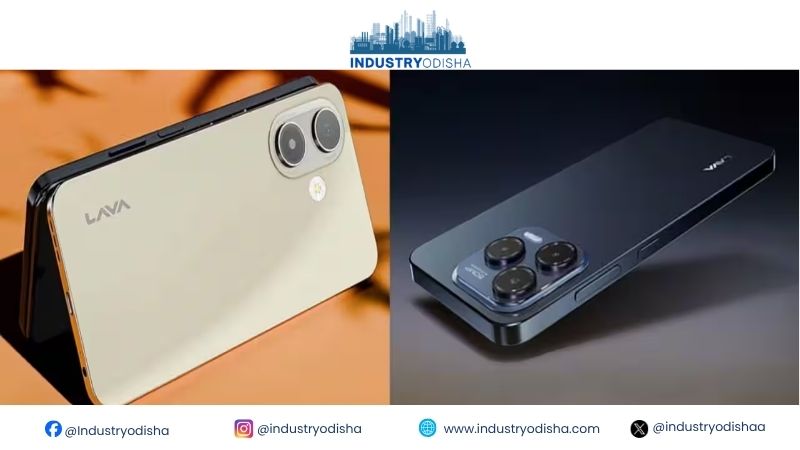
Industry Odisha Bureau, Oct 08: A ₹62,500-crore scheme is drawing Dixon Technologies, Optiemus Infracom and Lava. The incentive aims to create Indian-owned smartphone brands, not just assembly lines. But weak demand and fierce rivals cloud the outlook.
India already builds smartphones for global brands. Few of those phones, however, carry an Indian name. Much of the value sits with brand owners, not assemblers. The Mobile Phone Manufacturing Scheme (MPMS) aims to change that.
The Ministry of Electronics and Information Technology (Meity) announced the scheme on 15 July. It was notified on 21 August, with a ₹62,500-crore outlay. The scheme supports local manufacturing as well as Indian-owned smartphone brands.
More than half a dozen companies are now weighing the opportunity. Electronics manufacturers Dixon Technologies and Optiemus Infracom are among them. Brands Lava, Mivi, Boltt and CMF are also showing interest. Meity has reportedly heard from four more firms, whose identities remain unclear.
None has formally applied yet. The firms are eyeing the Target Segment 2 (TS-2) category. Its framework is expected within three weeks, after which applications may follow. An executive familiar with talks says Optiemus Infracom and CMF may sign a definitive agreement. No deal has been confirmed. Neither company responded to Mint’s queries, nor did Dixon, Lava, Mivi or Boltt.
What the incentive offers
Approved firms can earn a cash incentive of up to 6.5% of annual sales. This covers local assembly, component manufacturing and domestic component sourcing. A further 3% is reserved for building a local R&D team. That team is expected to file global smartphone design patents from India.
Eligibility rules are strict. Applicants need 51% Indian ownership and mostly Indian citizens in senior management. Their global headquarters, patents and manufacturing must also sit in India.
The distinction matters. A phone made in India is not necessarily an Indian brand. Apple, for example, is a US brand manufacturing in China, Vietnam and India. It still keeps ownership of its iPhone patents. The policy seeks to move Indian firms beyond low-margin assembly towards owning brands and IP.
Gartner’s Rishi Padhi sees a strategic prize in artificial intelligence. Smartphones remain the main gateway for Indian consumers, he notes. Whoever controls the device may influence which AI platform runs on it. Indian brands could use this to push domestic AI services, such as Sarvam’s. Memory shortages, driven by data-centre demand, are squeezing device costs. Padhi says new Chinese memory suppliers could help Indian brands compete.
A tough market to enter
Not everyone is convinced. Navkendar Singh of IDC India says breaking into established strongholds will be very difficult. Two new Indian brands have gained little traction, he notes, citing no real innovation.
Singh sees a cost gap among phones priced below ₹15,000. Yet targeting it means returning to a low-cost game most brands have left. With wafer-thin margins, new brands lacking scale could struggle with operating costs.
Demand adds pressure. India is forecast to sell 125 million smartphones in 2026. That would be the lowest annual figure in a decade.
The MPMS may help Indian firms capture more value from electronics. Incentives can lower costs and reward local R&D. But they cannot create consumer demand on their own. For Dixon, Lava and others, making phones is the easier part. Building a brand buyers choose will be the real test.
