



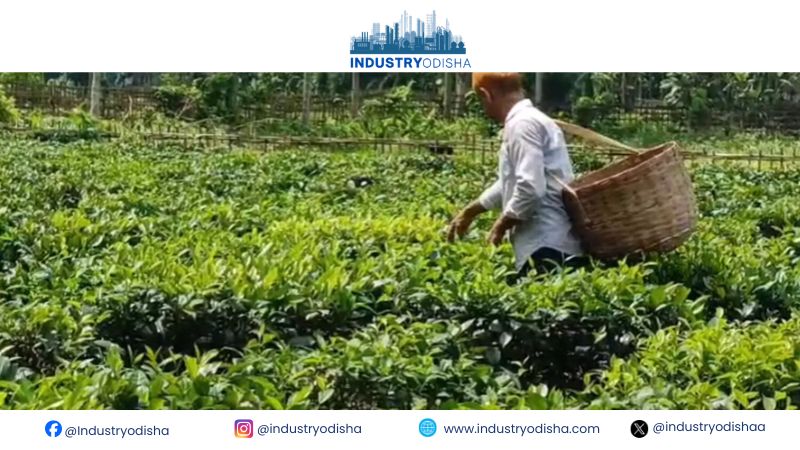
Industry Odisha Bureau, Sep 04: Tea Board India has partnered with NIT Rourkela and ISRO. This tripartite collaboration will develop an AI-based monitoring system. The project targets tea plantations across major growing regions. It combines satellite data, UAV inputs and ground-level observations. The initiative addresses crop stress, pest forecasting and yield estimation.
The partnership involves Tea Board India, NIT Rourkela and ISRO’s NRSC. National Remote Sensing Centre brings satellite and geospatial expertise here. NIT Rourkela contributes research capabilities for AI system development. Together, they’ve launched a project called CHAAYANKAN. This stands for Comprehensive AI-based Geospatial Data Analytics for Tea Plantation Monitoring.
The project timeline extends until March 2029. It will be implemented across India’s major tea-growing regions. This multi-year window allows for extensive data collection and testing. Implementation will proceed in phases as research progresses. No earlier completion date has been specified for this initiative.
Data collection forms the technical backbone of this system. Hyperspectral and optical remote-sensing data will come from satellites. UAVs will supplement this with aerial observations. Weather inputs and ground-level field data add further context. Entomological data will also feed into the broader monitoring framework.
These combined datasets will power AI and machine-learning applications. One key goal involves automatic mapping of tea-growing areas. Another focus is monitoring biotic and abiotic stress factors. Hyperspectral indices will help detect early signs of plantation stress. This could improve how stress conditions are identified and tracked.
Pest and disease forecasting represents another core project objective. The system aims to predict major threats facing tea gardens. Green leaf yield estimation will also be developed. This will rely on UAV- and satellite-based hyperspectral indices specifically. Neither forecasting accuracy nor yield outcomes have been quantified yet.
Tea Board India will provide crucial ground-level support throughout. It plans to use its existing administrative framework for this. This includes facilitating field-data integration across various tea-growing regions. Such support ensures satellite and AI insights connect with ground realities. The board’s involvement bridges research output with practical plantation management.
Beyond monitoring, the project could yield broader strategic value. It’s expected to generate a comprehensive data repository over time. This repository could inform future policy decisions for India’s tea sector. It may also strengthen technology-driven management practices industry-wide. However, these outcomes depend on successful project execution through 2029.
This collaboration reflects growing interest in agricultural technology adoption. Combining satellite intelligence, AI research and field expertise offers new possibilities. Whether it improves productivity and sustainability remains to be seen. For now, it marks a structured, multi-year effort. Success will depend on how effectively these diverse data streams integrate.
