



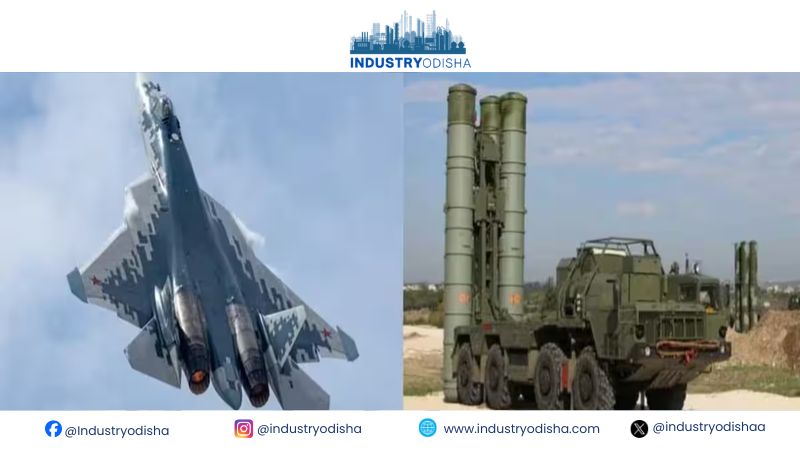
Industry Odisha Bureau, Sep 02: Russia is pitching the S-500 Prometheus and Su-57 Felon as major offerings for India. The proposals follow President Vladimir Putin’s meeting with Prime Minister Narendra Modi in Bishkek. India is simultaneously strengthening its air-defence architecture and overall combat aircraft strength. The Indian Air Force also faces a depleted fighter squadron strength challenge. India is meanwhile developing indigenous alternatives while diversifying its broader defence supplier base.
The S-500 is described as Russia’s newest long-range air and missile-defence system. Moscow is positioning the S-500 as a possible successor to India’s S-400. India’s S-400 systems reportedly performed prominently during last year’s Operation Sindoor engagements. One S-400 reportedly downed a Pakistani airborne early-warning aircraft at extraordinary range. Russia has now submitted a fresh proposal for five additional S-400 squadrons. That fresh proposal could potentially double the number of squadrons already contracted.
India is simultaneously testing elements of Project Kusha, an indigenous air-defence programme. Project Kusha is intended to eventually provide an Indian alternative to the S-400. India must weigh whether the S-500 fills a genuine remaining capability gap.
Russia’s second major proposition remains the Su-57 Felon fifth-generation stealth fighter jet. Moscow has intensified the pitch as the IAF faces depleted squadron numbers. India currently lacks an operational indigenous fifth-generation stealth fighter of its own. Moscow has indicated technology transfer and local production could form part of any deal. The IAF has described the Su-57 as a possible stopgap before AMCA arrives. AMCA is India’s indigenous programme intended to deliver a future stealth fighter. China reportedly operates more than 500 J-20 stealth fighters across its fleet. Pakistan is expected to soon receive Chinese J-35 stealth fighters as well.
Adding the Su-57 would introduce another type into India’s already varied fighter fleet. Each additional aircraft type brings separate training, maintenance, spares and logistics requirements. The Su-57 pitch also recalls the abandoned India-Russia Fifth Generation Fighter Aircraft project.
India has steadily diversified its defence suppliers over roughly two decades now. New Delhi recently advanced its procurement of American Javelin anti-tank guided missiles. A separate purchase of 114 Rafale fighters from France is also progressing. Yet Moscow retains a significant structural advantage from decades of military cooperation. Russian-origin fighters, tanks, submarines and missiles remain deeply embedded across India’s forces. Behind the Bishkek meeting lies a competitive battle over India’s future military composition. Russia’s two propositions raise difficult strategic questions for Indian defence planners now.
