



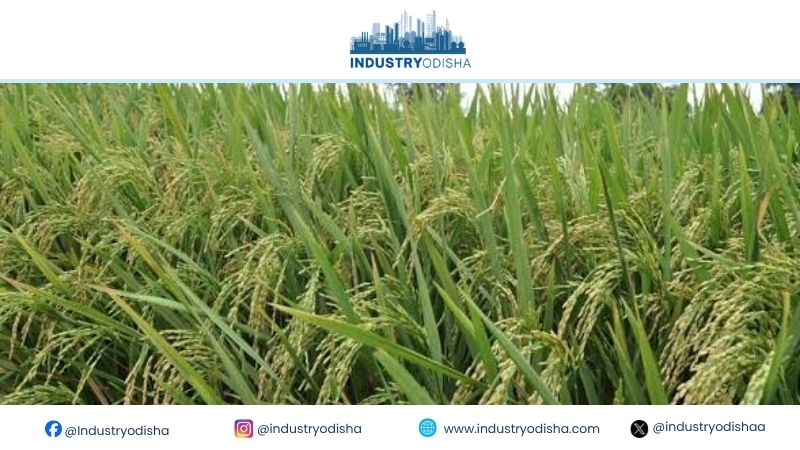
Bargarh, Aug 28: Odisha’s agricultural heartland, stands at a critical juncture. Once India’s largest rice producer, this district of 1.6 million hectares under cultivation continues to dominate the state’s rice economy, yet faces mounting pressure from competing regions and plateauing yields. Agricultural experts and officials now advocate for transformative investments—establishing a dedicated rice research centre, setting up farmer training institutes, and facilitating international exposure visits—as the pathway to reclaiming Bargarh’s status as the nation’s premier rice producing destination.
The Current Landscape
Bargarh’s agricultural calendar revolves around two principal cropping seasons: Kharif (monsoon) and Rabi (winter). The Kharif season, spanning June to October, leverages the southwest monsoon and accounts for approximately 60% of annual rice production. The Rabi season, from October to March, depends heavily on irrigation infrastructure and contributes the remaining 40% of the district’s rice yield.
According to district agricultural records, Bargarh produced 2.8 million tonnes of rice in the 2022-23 season, representing 18% of Odisha’s total output and 4.2% of India’s rice production. However, productivity metrics present a sobering picture: average yields stand at 4.8 tonnes per hectare—roughly 15-20% below leading rice-producing states like Punjab and Haryana, which achieve 6.5 to 7.2 tonnes per hectare respectively.
Structural Gaps in Agricultural Infrastructure
The underperformance stems from three critical deficiencies:
● Research and Development: Unlike Punjab’s Punjab Agricultural University and Tamil Nadu’s Tamil Nadu Agricultural University, Odisha lacks a dedicated rice research centre focused on high-yielding, climate-resilient varieties suited to regional soil and water conditions. Research conducted at state-level institutions often lacks localized adaptation, limiting breakthrough innovations.
● Skill Gaps Among Farmers: Only 35% of Bargarh’s 410,000 farming households have access to formal agricultural training. Modern techniques in precision seeding, nutrient management, integrated pest management, and climate-adaptive practices remain largely unknown to smallholder farmers, who constitute 72% of the cultivator base.
● Global Knowledge Deficit: Farmers have minimal exposure to international best practices employed in Vietnam (5.8 tonnes/hectare), Thailand (6.0 tonnes/hectare), and other leading Asian producers. Absence of study missions and exposure visits limits adoption of proven technologies.
A Three-Pronged Strategy for Agricultural Excellence
Establishment of Bargarh Rice Research Centre
A dedicated research institute focusing on rice varietal improvement, soil health management, and agronomic practices tailored to Bargarh’s agro-climatic conditions would catalyze productivity gains. The centre should prioritize developing short-duration, high-yielding, disease-resistant varieties suited to both Kharif and Rabi seasons. Such research has historically yielded 15-25% yield improvements within 5-7 years, as evidenced by similar institutions across India.
Farmer Training and Capacity Building
District-level Farmer Training Institutes must be established with syllabi focused on contemporary agricultural practices: resource-efficient irrigation, balanced nutrition application, crop health diagnostics, and climate adaptation strategies. Training farmers through demonstration plots and farmer field schools has proven effective in disseminating knowledge—states implementing such programs report adoption rates exceeding 60% within two cropping seasons.
International Exposure and Knowledge Exchange
Sponsored study tours to advanced rice-producing nations—particularly Vietnam, Thailand, and China—would expose extension workers and progressive farmers to mechanized cultivation, precision agriculture technologies, water-efficient farming systems, and quality certification protocols. Such exposure directly translates to on-farm innovations: farmer groups returning from international visits implement an average of 4-6 technology adoptions, generating yield increases of 1.2-1.8 tonnes per hectare.
Reclaiming Regional Leadership
If these interventions are implemented systematically, Bargarh can elevate productivity from current 4.8 to 6.5 tonnes per hectare within a decade—an increase of 35%. This would translate to an additional 2.7 million tonnes annually, positioning Bargarh as India’s undisputed rice capital and the world’s second-largest producing district after Thailand’s Surin.
The infrastructure investments required—estimated at ₹400-500 crores—pale in comparison to anticipated returns: increased farmer incomes, enhanced export competitiveness, and strengthened national food security.
Bargarh’s rice heritage spans centuries. With strategic state and central government investments in research, training, and international collaboration, this historic rice bowl stands ready to reclaim its place at the apex of India’s agricultural hierarchy.
