



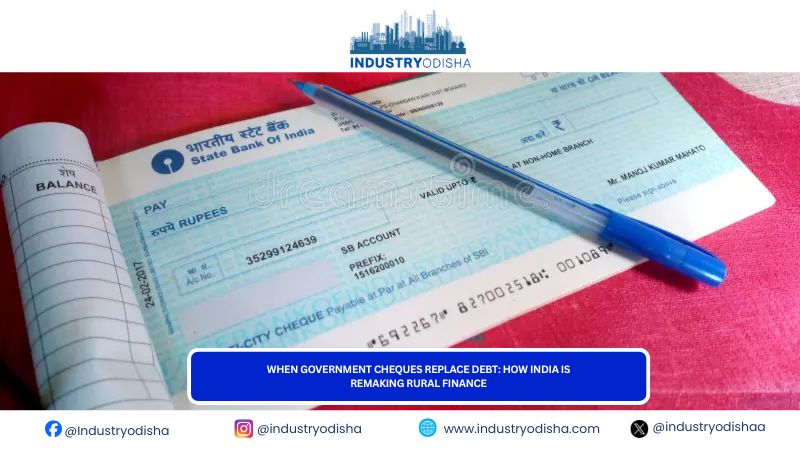
Industry Odisha Bureau, Aug 1: For millions of Indian farmers, a predictable annual payment has become more valuable than any policy announcement. After seven years of direct transfers accumulating to over ₹4.47 lakh crore, the Pradhan Mantri Kisan Samman Nidhi has fundamentally altered how rural households manage their finances and what they can invest in tomorrow.
The Union Cabinet’s decision to extend the scheme through 2030 commits an additional ₹3.15 lakh crore to sustain the ₹6,000 annual income support that has reached nearly 9.5 crore farmers. But the significance extends beyond the financial commitment. The scheme represents a deliberate policy architecture designed to replace the informal credit economy that has historically trapped smallholders in cycles of debt and stagnation.
Understanding this transformation requires looking beyond headline numbers. The scheme began modest ₹6,000 annually spread across three instalments yet its impact on rural decision-making has proven disproportionate. By channelling funds directly into farmers’ bank accounts through India’s Direct Benefit Transfer infrastructure, the government created a mechanism that combines predictability with transparency. Farmers know when money arrives and in what amount, enabling planning that informal lenders fundamentally disrupt.
This reliability generates cascading economic effects. Rather than borrowing from local moneylenders at punitive rates to purchase seeds or fertilizer, farmers increasingly finance these inputs from government transfers. The data illustrates the pattern: PM-KISAN assistance has funded investments in seeds, fertilizers, irrigation systems, and agricultural machinery precisely the inputs that drive productivity improvement. More significantly, farmers have simultaneously reduced dependence on informal credit networks that absorb substantial portions of agricultural income through interest payments.
Women farmers now represent approximately one in four beneficiaries, having collectively received over ₹1.06 lakh crore. This shift carries economic significance beyond poverty alleviation. Women’s direct access to government income support strengthens their decision-making authority within households and their participation in agricultural markets a transformation that ripples through rural economies and food-production systems.
The scheme’s continuation through 2030 signals institutional confidence in a model that marries financial inclusion with agricultural modernization. The architecture created through seven years of transfers bank account linkages, digital payment systems, beneficiary databases now provides foundations upon which the next phase of rural transformation could build. Strengthening agricultural extension services, accelerating precision farming adoption, or expanding mechanization access could each leverage the existing infrastructure to accelerate productivity gains. For rural India, the question increasingly shifts from whether income support will continue to how that support can catalyze agricultural modernization.
