



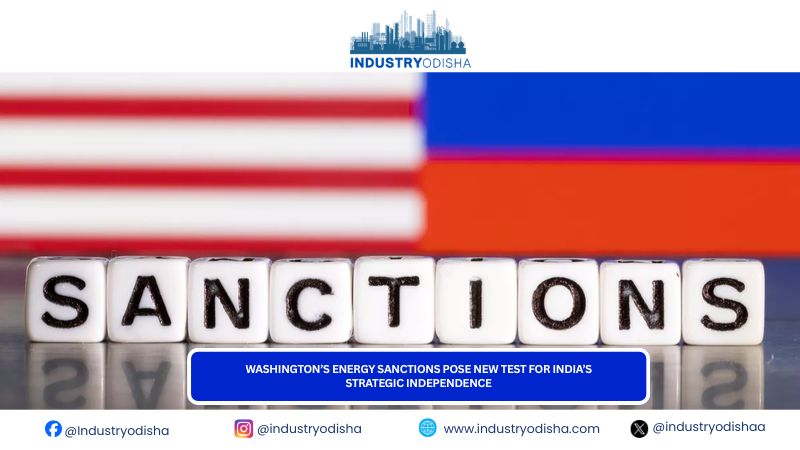
Industry Odisha Bureau, Aug 2 :- Energy has emerged as the currency of modern statecraft. As Washington escalates economic pressure on Moscow through unprecedented tariff threats, India faces a defining moment: navigate between major-power competition while protecting the economic requirements of its 1.4 billion citizens.
The Sanctioning Russia and Iran Act of 2026, approved by the U.S. Senate with an 86-12 majority, represents a significant shift in American sanctions doctrine. Rather than targeting Russia alone, the legislation would empower the U.S. President to impose tariffs of up to 100 percent on countries purchasing substantial Russian oil and natural gas volumes a mechanism designed to weaponise trade against energy importers who refuse Washington’s preferred alignment.
India occupies an uncomfortable position in this schema. Identified as among the world’s five largest Russian energy importers alongside China, Slovakia, Hungary, and Azerbaijan, New Delhi could face substantial tariff penalties if it continues current purchasing patterns. Under Section 113 of the proposal, the U.S. Trade Representative would conduct reviews every six months to assess compliance, effectively creating rolling economic leverage over India’s energy independence.
India’s diplomatic response has been carefully calibrated. The Ministry of External Affairs has emphasised that energy procurement decisions are driven by national imperatives and energy security requirements not external pressure. Delhi has reiterated its commitment to diversified sourcing, explicitly including American suppliers, while signalling active engagement with Washington on the matter.
The legislation also targets nations facilitating Russia’s “shadow fleet,” an infrastructure arrangement that India has thus far avoided directly supporting.
India’s position reflects a broader strategic reality: developing economies cannot surrender energy security to geopolitical alignment. The nation requires affordable, reliable hydrocarbon supplies to sustain growth and development.
Building on its established diplomatic channels, India could accelerate long-term energy supply diversification, expand renewable energy capacity, and strengthen partnerships across multiple suppliers and regions. These initiatives would complement existing efforts to safeguard energy security while maintaining strategic autonomy in an increasingly complex geopolitical environment.
