



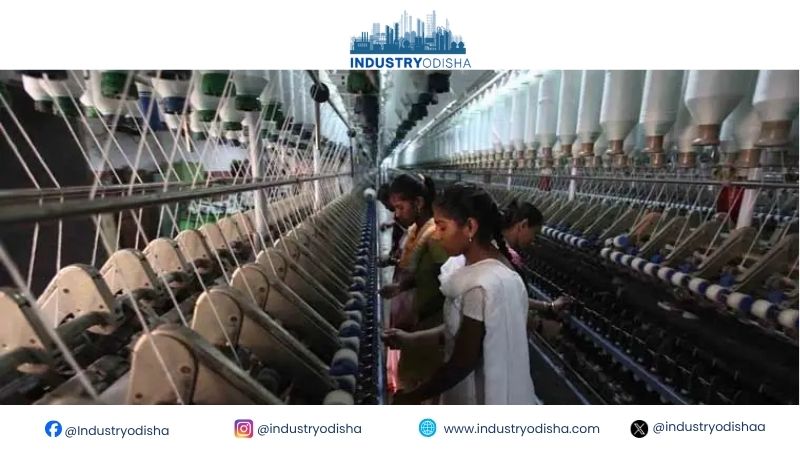
Industry Odisha Bureau, Oct 19: The proposed Samarth 2.0 plan aims to build a larger pool of factory-ready textile workers. It is meant to lift productivity as India chases export gains under trade deals.*
The govt is weighing a plan for a ₹25,000-crore skilling push in textiles. The outlay would run over five years, two people aware of the matter said. The aim is to sharpen a labour-intensive industry’s export competitiveness amid global trade tensions.
The proposal, called Samarth 2.0, would mark a sharp step-up in spending. Samarth 1.0 spent ₹740 crore over the five years to March 2026. The scheme’s allocation for 2026–27 stands at ₹300 crore. If approved, the outlay would be over 30 times Samarth 1.0’s five-year spend.
The Expenditure Finance Committee has already examined the textiles ministry’s proposal. This inter-ministerial body appraises government schemes before they advance. The plan could soon go to the Union Cabinet for final approval. It has not yet received that clearance.
The sector is India’s largest employer after agriculture. It directly employs about 45 million people and supports over 100 million livelihoods. Most of them are women and rural workers. Better skills could lift rural incomes, provided training turns into real jobs.
Announced in the 2026–27 budget, Samarth 2.0 seeks to modernise the skilling framework. It would link industry more closely with academic institutions. The focus is on preparing workers for changing technology and industry requirements. Once cleared, delivery would run through industry partners, academic bodies and sectoral organisations.
Raja Shanmugam, a knitwear exporter and former Tiruppur Exporters’ Association chief, welcomed the plan. He said a wider programme could ease the shortage of trained workers. But success, he argued, should be judged by productivity and employability, not headcounts. Training must track shifts in technology, quality standards and global buyer demands, he said. He wants exporters and training institutes to work together on factory-relevant skills.
India aims to more than double textile and garment exports to $100 billion by 2030. Free trade agreements (FTAs) are central to that goal. Textiles minister Giriraj Singh has said India’s 15 FTA partners form a $198-billion textiles market. India currently ships only $11.5 billion of textiles to them. That gap signals headroom, but winning share needs capacity, competitive costs and reliable supply.
India’s FTA with the UK took effect this year. Its pact with the European Union is due to start in early 2027. Together, the two form India’s largest textile market after the US. Industry executives say the EU levies duties of up to 12% on Indian textiles. Rival Bangladesh enjoys duty-free access as a least developed country. The FTA could narrow that gap, but productivity and quality will still decide outcomes.
Samarth 1.0, launched in 2017, offers a baseline. It covers entry-level training, upskilling and reskilling, but excludes organised spinning and weaving. Its dashboard shows 7,38,182 entry-level trainees across 4,614 centres as of 16 October. Another 26,786 workers were upskilled or reskilled. Those figures track training, not confirmed jobs or productivity gains.
Samarth 2.0’s impact will hinge on Cabinet approval and sound execution. Measurable gains in skills and jobs will matter more than the headline sum.
