


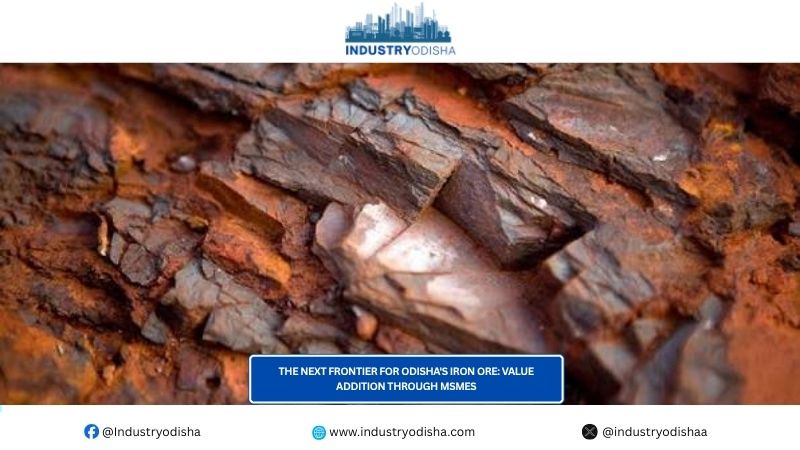
The Odisha government has intensified its mineral development strategy by targeting the auction of 34 mineral blocks, including several iron ore and manganese blocks, in 2026-27, while simultaneously pushing for greater steel capacity and downstream industrial growth.
The state’s renewed mining push comes at a time when India plans to significantly expand steel production to meet infrastructure, housing and manufacturing demand. Odisha, which contributes over half of India’s iron ore production, is naturally positioned to become the backbone of this expansion.
For decades, Odisha has been celebrated as India’s mineral powerhouse. It accounts for 55% of India’s iron ore production, far ahead of Karnataka (16%) and Chhattisgarh (15%). Districts such as Keonjhar, Sundargarh and Mayurbhanj have emerged as the backbone of India’s steel industry. In 2024-25, India produced about 278 million tonnes of iron ore, of which Odisha contributed nearly 153 million tonnes. No other state enjoys such dominance in a single mineral.
Its iron ore has built steel plants across the country, fuelled infrastructure growth and generated substantial revenues for the state. But the latest push to auction more iron ore blocks prompts a larger policy question: Should Odisha continue to earn primarily from extraction, or should it leverage its mineral wealth to create an ecosystem of manufacturing-led prosperity?
Past records suggest that mining alone cannot maximise economic returns. Every tonne of iron extracted generates royalty and mining revenue for the state. But according to experts, real economic value is created when that ore is transformed into steel, engineered products, machinery and consumer goods.
Today, much of this downstream manufacturing happens outside Odisha. Consequently, while Odisha earns from extraction, other states capture the benefits of fabrication, engineering, component manufacturing, exports and skilled employment.
Closing this gap could transform the state’s economy.
MSMEs: The Real Wealth Creators
Iron ore is often linked with large steel plants, but its real economic value lies in the thousands of MSMEs that convert steel into high-value products—from agricultural implements, auto components and railway equipment to industrial machinery, fabricated structures, pipes, transmission towers and engineering tools.
Each MSME adds value, creates jobs and strengthens the industrial supply chain. By nurturing such enterprises across its mining districts, Odisha can move beyond a few large industries and build a broad-based manufacturing ecosystem that drives inclusive growth.
Build Industrial Clusters
The first step towards it is building MSME clusters around existing steel hubs such as Kalinganagar, Angul, Jharsuguda, Rourkela and Joda-Barbil instead of establishing isolated factories. Such clusters will allow small enterprises to share infrastructure, logistics, testing facilities, design centres and common skill development institutes. This will reduce production costs while increasing competitiveness.
Countries like Germany, Japan and South Korea have demonstrated how networks of specialised small manufacturers have become the backbone of industrial exports.
Employment Multiplier
Mining is highly mechanised. A modern mine produces enormous quantities of ore with comparatively few workers. But Manufacturing tells a different story. For every direct job in a steel plant, downstream manufacturing creates multiple additional jobs in fabrication, machining, assembly, maintenance, packaging, transportation, marketing and exports. Thousands of young diploma holders, ITI graduates, welders, electricians, machine operators and engineers can find employment close to their homes instead of migrating to other states.
More importantly, MSMEs create entrepreneurs—not merely employees.
Strengthen Local Supply Chains
Odisha’s growing steel industry imports several fabricated components from industrial centres in Maharashtra, Gujarat, Tamil Nadu and Punjab.
This presents a significant opportunity. If local MSMEs manufacture these products, steel plants can source them within the state, reducing logistics costs while strengthening local industry.
A strong supplier ecosystem can also make Odisha more attractive for future investments in engineering, automobiles, defence manufacturing and renewable energy.
Generate Revenue
Mining royalties are only one part of the state’s earnings. Real fiscal gains arise when minerals are transformed into finished products. A vibrant MSME ecosystem can expand the state’s tax base through GST collections, electricity consumption, industrial land use, commercial transactions and employment-linked economic activity.
As industries grow, so do transport services, warehousing, banking, insurance, housing and retail markets, each contributing additional revenue.
Instead of earning from a single stage of production, Odisha can start a new chapter by earning from every stage of the value chain.
Boost Exports
Global demand for engineering goods, fabricated steel products, industrial machinery and precision components continues to rise. Odisha has the raw material, ports, expanding logistics infrastructure and improving industrial connectivity to become an export hub.
Rather than exporting primarily iron ore and semi-finished steel, the state can export high-value manufactured products that generate significantly greater foreign exchange and local income.
The Green Opportunity
The global steel industry is moving towards low-carbon production. This transition opens new markets for manufacturers producing components for renewable energy, electric vehicles, green buildings and modern infrastructure. Odisha’s MSMEs can become suppliers of wind turbine towers, solar mounting structures, EV components and green construction materials, positioning themselves in emerging global supply chains.
Odisha’s iron ore has long powered India’s industrial growth. It is now time for it to power Odisha’s own economic transformation. The state has minerals, ports, steel plants and policy momentum. What it needs next is an army of MSMEs that can turn iron ore into jobs, innovation, exports and lasting prosperity. Only then can the state inch towards fulfilling the goals of Viksit Odisha 2036 by moving from being India’s mining capital to becoming one of its manufacturing powerhouses.
