

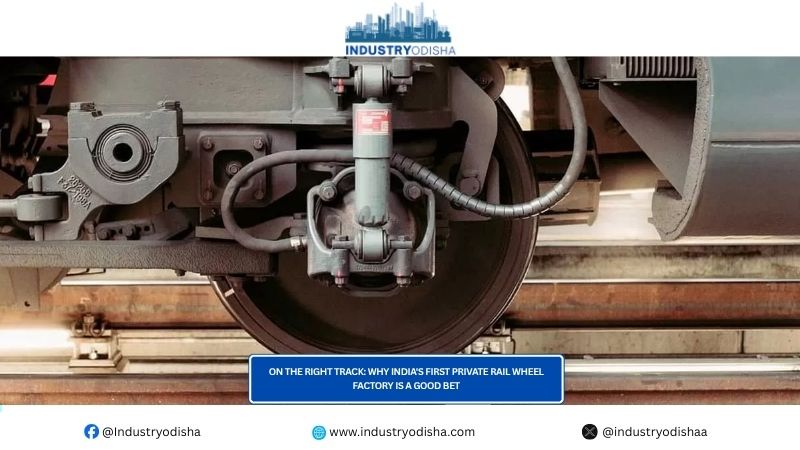
As India accelerates towards becoming a $5 trillion economy, the race is no longer just about building roads, ports and railways; it is equally about creating the manufacturing ecosystem that powers this infrastructure revolution. Against this backdrop, the foundation of India’s first private rail wheel and axle manufacturing facility at Khordha is more than another industrial project. It is a milestone in India’s quest for self-reliance in critical railway components and a defining moment in Odisha’s industrial transformation.
With an investment of ₹2,500 crore and an annual production capacity of 100,000 wheelsets, the plant is set to emerge as one of the largest such facilities in Asia. The project, which is being developed by Jupiter Tatravagonka Railwheel Factory (JTRF) is expected to manufacture 100,000 wheelsets annually and commence operations by 2027. Nearly half of its production is earmarked for exports, making it one of the few industrial projects in eastern India designed from the outset to serve global markets.
Marks a shift in India’s industrial policy
The inauguration of India’s first private-sector rail wheel and axle manufacturing facility is significant not merely because of the investment it brings, but because it marks a fundamental shift in India’s industrial and railway policy.
For decades, the production of critical railway components such as wheels and axles remained largely the domain of public sector units and government-owned manufacturing facilities. The entry of private players into this strategically important segment reflects New Delhi’s growing confidence in leveraging private capital, technology and innovation to support national infrastructure goals.
This transition mirrors the broader reforms undertaken in sectors such as defence manufacturing, space technology and civil aviation, where the government has gradually moved from being the sole producer to becoming a facilitator and regulator. In railways too, the emphasis is shifting from state monopoly to collaborative growth involving both public and private enterprises.
Boost for Vande Bharat trains
The timing could not be more crucial. Indian Railways is undergoing the largest expansion and modernisation drive in its history. The rapid rollout of Vande Bharat trains, dedicated freight corridors, high-capacity freight wagons and future semi-high-speed rail networks will require millions of wheels and axles over the coming decades. Until now, domestic production capacity often struggled to keep pace with demand, forcing India to rely on imports for certain requirements. Such dependence not only increases costs but also exposes critical infrastructure projects to global supply chain disruptions.
A step towards Atma Nirbhar Bharat
More importantly, it is a significant step towards realising the vision of Atmanirbhar Bharat— moving from consumption to production and from imports to indigenous manufacturing. Rather than importing high-value engineering products, India will now be able to manufacture them using domestically available steel and engineering expertise. This increases value addition within the country and ensures that economic benefits remain within the national economy.
Another important contribution is technological self-reliance. Rail wheel and axle production requires sophisticated forging, machining, testing and quality-control technologies. The facility will help build domestic expertise in these advanced manufacturing processes, reducing dependence on foreign technology and creating a pool of skilled manpower capable of supporting India’s growing railway ambitions.
Step towards making India a global railway manufacturing hub
With a significant portion of production earmarked for exports, the facility will enable India to move beyond serving its domestic market and compete internationally in a specialised engineering segment dominated by a handful of countries. This will generate valuable foreign exchange earnings while enhancing the country’s reputation as a producer of high-quality railway equipment.
For Odisha, the benefits are transformative. The state has long contributed to India’s industrial growth through its abundant mineral resources. However, the wheel and axle factory represents a move up the value chain—from mining and raw material production to sophisticated engineering manufacturing. It is expected to create a network of ancillary industries, attract skilled talent, promote technology transfer and generate thousands of direct and indirect employment opportunities.
At a broader level, the project demonstrates how India’s industrial policy is evolving. The focus is no longer only on building infrastructure but also on creating domestic manufacturing ecosystems around that infrastructure. Just as Vande Bharat trains have become symbols of a modernising railway network, the private rail wheel and axle factory in Odisha symbolises a new economic philosophy—one that seeks to combine public vision with private enterprise to accelerate India’s journey towards becoming a global manufacturing powerhouse.
