



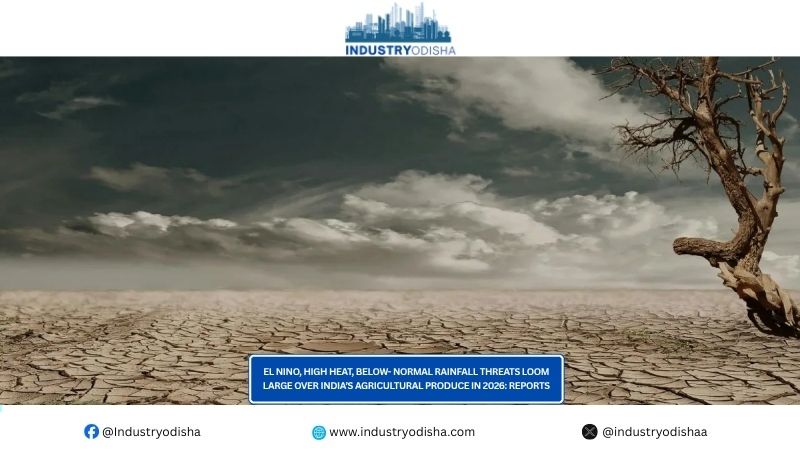
Industry Odisha Bureau, Jun 25: Despite the onset of annual south-west monsoon this month and its gradual progress across India, the forecast of below-normal monsoon impacted by the El Nino this year has put everyone, especially the Indian farmers, on tenterhooks as it is expected to adversely affect the agricultural produce since India remains significantly an agrarian economy.
Reportedly, the India Meteorological Department (IMD) and the US National Oceanic and Atmospheric Administration (NOAA) have predicted “a moderate-to-strong El Niño this year that suppresses the vertical air movement needed for rainclouds to form and a warming Pacific Ocean weakens the trade winds that bring moisture to the Indian subcontinent.”
It has also been reported that, “The nationwide deficit of the south-west monsoon has increased from 35% to 43%. While northwest India has received 5% more rain than normal, central India and the northeast face deficits of 63% and 43%, respectively.”
Experts warn that high heat and rainfall shortage “could reduce farm productivity during the agricultural activites.”
Since India’s rural economy is reportedly “built around the assumption of reliable rainfall delivery”, the threats of El Nino, high heat and below-normal rainfall this time are very likely to affect India’s agricultural economy as well as aggravate the retail food inflation.
Notably, “India is often described as an agrarian economy due to the substantial role agriculture plays in its socio-economic structure. As of recent data, agriculture employs about 49% of the Indian workforce, although this figure has decreased from around 75% at the time of independence. Despite this high employment rate, agriculture’s contribution to the Gross Domestic Product (GDP) has fallen to less than 20%, indicating a shift towards industrialization and services. In the 1970s, agriculture accounted for about 40% of India’s GDP, while the country is transitioning from a predominantly agrarian economy to a more diversified economic landscape, but agriculture continues to play a vital role in the livelihoods of millions.”
