



Odisha Chief Minister Mohan Charan Majhi has pitched for the development of an Orange Economy—a culture-driven economic model, as a key strategy for employment generation and tourism-led growth in the state.
Speaking at a special event held recently at the historic Lingaraj Temple to mark the 75th anniversary of the reconstruction of the Somnath Temple, Majhi said Odisha’s rich spiritual and cultural heritage could become a major engine of economic transformation.
Majhi said promoting the “Orange Economy” by leveraging culture, pilgrimage and tourism would not only preserve heritage but also create sustainable livelihood opportunities for local communities across the state.
What is Orange Economy
Coined by the Inter-American Development Bank (IDB) and popularised by UNESCO, Orange Economy (or creative economy) refers to sectors where value is generated through creativity, culture and intellectual property (IP). It comprises industries like film, gaming, digital content, fashion, design and handicrafts.
Why Odisha is promoting Orange Economy
From Jagannath culture and classical dance to handlooms, tribal art, temples, festivals, cuisine and storytelling traditions, Odisha possesses enormous untapped creative wealth. The state government sees these not merely as symbols of identity, but as engines of employment, entrepreneurship, tourism and global branding. Chief Minister Majhi has recently emphasised that Odisha’s cultural heritage can drive tourism-led growth and create jobs for local youth.
Moreover, with the central government identifying sectors such as animation, gaming, VFX, film, digital content and cultural enterprises as future growth drivers under the Orange Economy, Odisha wants to position itself early in this emerging ecosystem.
Most importantly, as creative industries such as tourism, handicrafts, filmmaking, music, gaming and cultural entrepreneurship are labour intensive and youth driven, they can create large-scale jobs across urban and rural Odisha. Every temple corridor, festival circuit, heritage town, craft village, or film shoot can stimulate hotels, transport, local markets, artisans and small businesses.
Besides, Odisha wants to build a similar global identity around Jagannath heritage, Odissi dance, tribal traditions, handloom clusters, eco-tourism and spiritual tourism, and emerge as a soft power.
Above all, the state is trying to transition from a resource-dependent economy to a knowledge and creativity-driven economy. The state is simultaneously investing in AI, biotechnology, digital innovation, and startup ecosystems. The Orange Economy complement this vision by encouraging creative entrepreneurship among young people.
The state has stepped up by focusing on cultural tourism. Odisha is investing heavily in temple corridors, heritage conservation, eco-tourism and festival promotion to attract both domestic and international tourists. Destinations linked to Lord Jagannath, Buddhist heritage, tribal culture and coastal tourism are being marketed as part of Odisha’s cultural identity. Major events such as the Rath Yatra, Konark Dance Festival, Bali Jatra, and hockey-related cultural showcases are being used to strengthen the state’s tourism economy.
The state is also promoting handicrafts and handlooms through branding, exhibitions, exports and artisan support schemes. In fact, during his recent visit to Norway, PM Narendra Modi gifted silver filigree and Pattachittra to Norway King and Queen, respectively. CM Majhi informed on his X handle.
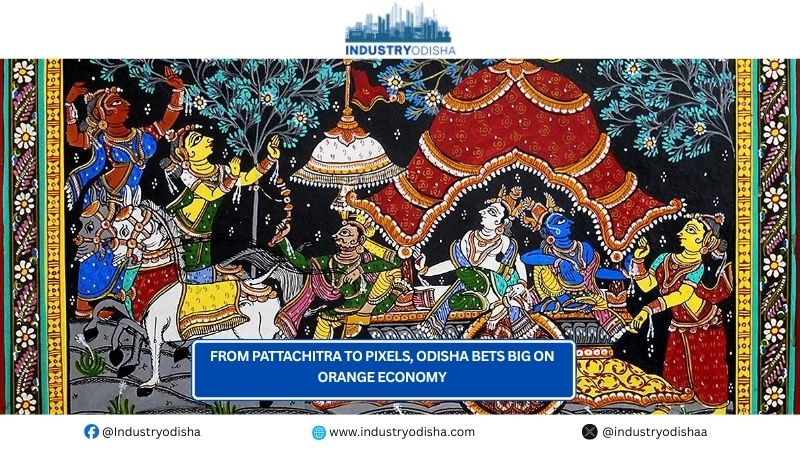
Besides, Odisha’s famous products such as Sambalpuri textiles, silver filigree, Pattachitra paintings, appliqué work and tribal art are positioned not merely as traditional crafts, but as globally marketable creative products. Government-backed initiatives are helping artisans access digital platforms and national markets.
Odisha is encouraging startups, animation, digital media, gaming, filmmaking, music and content creation through startup policies and skill-development programmes. The state’s growing push in technology and AI complements the Orange Economy by creating opportunities for young creative entrepreneurs.
The state is also using sports and culture together as soft power tools. Events such as the Men’s Hockey WorldCup helped project Odisha globally through cultural showcases, tourism campaigns and branding exercises. The state has understood that culture today is not just about preservation — it is also about visibility, identity, and economic influence.
Skill training in tourism, hospitality, crafts, media and entrepreneurship is also gaining attention.
By turning heritage, creativity, tourism and traditional arts into drivers of growth, the state is redefining development itself: proving that culture is not merely identity to preserve, but capital capable of generating jobs, innovation and global influence.
