


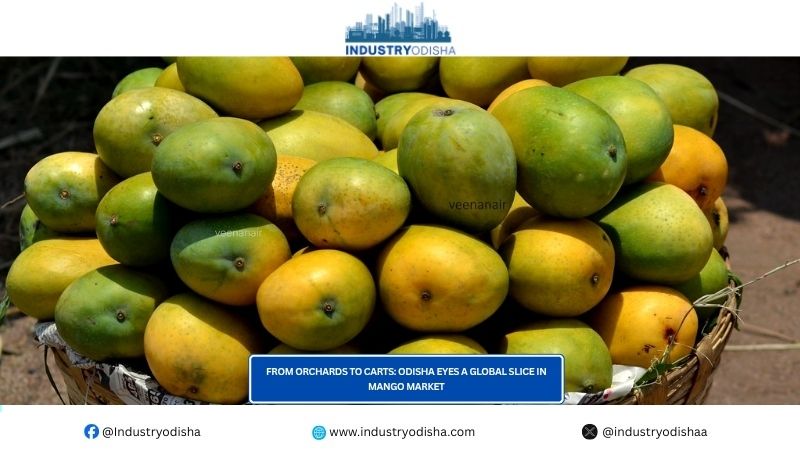
Odisha kicked off its 2026 mango season in style as it exported around 7.5 quintals of premium Amrapali mangoes from Dhenkanal to London recently, marking a quiet agricultural revolution in the state.
India, the largest producer of mangoes in the world produces over 22 million tonnes annually and accounts for nearly 45% of global production. However, despite this feat, the country remains a relatively small player in the global mango trade.
Odisha’s recent export breakthroughs suggest that the state can fill that gap, not by competing on volume with established players, but by creating a premium niche built on quality, unique varieties, farmer collectives and smart branding.
Mangoes constitute the single largest fruit crop in the state, contributing nearly one-third of Odisha’s fruit production and acreage. It occupies a significant area across districts such as Mayurbhanj, Dhenkanal, Angul, Keonjhar, Koraput, Rayagada, Gajapati and Kandhamal. While commercial varieties like Amrapali, Dashehari, and Himsagar are cultivated, Odisha is also home to several indigenous varieties that remain largely unknown outside regional markets.
Recognising the need and demand for the king of fruits, the state’s deputy chief minister and agriculture minister KV Singh Deo has urged farmers to develop a distinct brand identity for its mangoes so that it can become Odisha’s unique selling proposition. Distinct taste profiles, unique aroma and traditional cultivation methods can help create premium branding in international markets.
Here’s how Odisha can become an important player globally:
Focus on value over volume
As it would be challenging to compete with established mango-exporting regions based on production alone, the state should focus on premium and indigenous varieties that can command higher prices in international markets. Just as Alphonso is synonymous with Maharashtra and Kesar with Gujarat, Odisha must identify and promote its unique mango varieties under a distinct brand identity.
Strengthen export infrastructure
To compete in premium global markets, the state should procure modern pack houses, cold storage facilities, irradiation units, quality-testing laboratories and efficient logistics networks to meet international phytosanitary standards.
A strong Farmer Producer Organisation
Role of Farmer Producer Organisations are very important in the success of exporting fruits and vegetables. The recent success of mango exports from Dhenkanal has shown how collective marketing can help small farmers access international buyers, ensure quality consistency and secure better prices.
Encourage lesser use of chemicals
Odisha should leverage its relatively low-chemical cultivation practices in tribal and hilly districts to target the growing global demand for organic and residue-free fruits. Premium consumers in Europe, Japan, and the Gulf are increasingly willing to pay more for sustainably produced food.
Strict quality control measures
In view of rejection by Japan and Nepal over flouting the quality control measures, the state should adopt strict norms as per international standards. Quality checks should be done before exporting so that there’s no loss of money. More importantly, it won’t bring a bad name for the country.
Value addition is equally important. Instead of relying solely on fresh fruit exports, Odisha can develop a thriving mango-processing industry producing pulp, juices, concentrates, dried mango products and pickles. This would reduce post-harvest losses and create year-round income opportunities.
Finally, Odisha must invest in branding and market promotion. Participation in international food exhibitions, securing GI tags for distinctive varieties and launching a unified “Mangoes of Odisha” campaign can help create a strong global identity.
Odisha stands at a pivotal moment where it can choose to remain a supplier of fruit or emerge as a creator of a premium global brand. With its unique varieties, growing export footprint, strategic ports and vast farmer base, the ingredients for success are already in place. What is needed now is ambition. If Odisha can combine branding with infrastructure, quality with innovation and production with market intelligence, its mangoes can become for the state what tea is for Darjeeling and wine is for Bordeaux—a symbol of identity, pride and prosperity.
The opportunity is ripe; Odisha must seize it before others do.
