


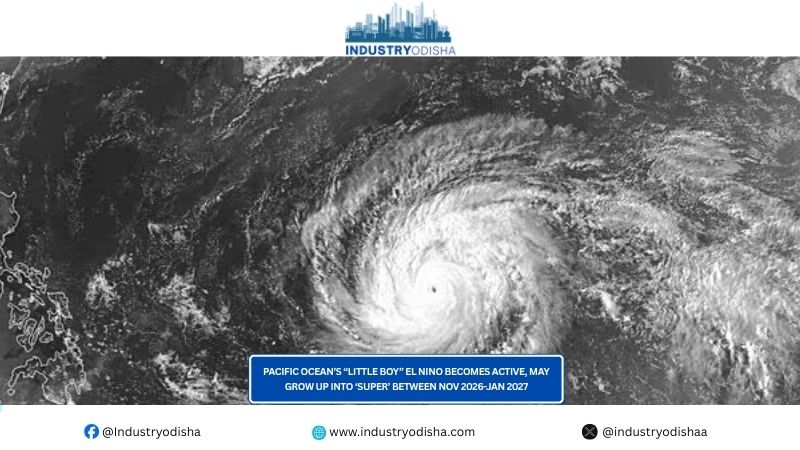
Industry Odisha Bureau, Jun 12: As the US National Oceanic and Atmospheric Administration (NOAA) has declared the arrival of El Nino conditions and has also indicated a 63% likelihood of turning into “Super” (a very powerful one) between November 2026 and January 2027, it has raised grave concerns among the weather experts with regard to its effects on the global climate in the upcoming months, and especially on the annual south-west monsoon in India.
According to the ocean scientists, “El Nino often leads to noticeable shifts in weather across many parts of the world resulting in heavier than normal rainfall and flooding in some parts of the world, while, on the contrary, causing severe droughts and heatwave in other parts of the world.”
As per media reports, “A very intense El Nino had caused torrential rainfall in Peru and other countries, while it had caused a severe drought in India and South-East Asia in 1957-1958.”
Media reports have also added: “The worst El Nino of the 20th century was recorded in 1982-83 when the most intense phenomenon caused extreme weather events throughout the world, including floods in the American Pacific and in the southern United States, and droughts in north-eastern Brazil and Indonesia. It also caused a very mild winter in the mid-latitudes of Europe, Asia and North America.”
It has also been reported that, “Some climate models suggest that this time’s El Nino could become one of the strongest on record and could possibly weaken the monsoon in India affecting agriculture, food prices and water availability over the next year (2027).”
Reportedly, the India Meteorological Department (IMD) has forecast “10% rainfall shortfall compared with the 50-year long-period average (LPA) for the 2026 monsoon season.”
Even though the south-west monsoon touched Kerala (that heralds the annual monsoon’s onset in India) on June 4 instead of the usual June 1, it has been reported that “India’s rainfall deficit stood at 27%” deemed to be a large shortfall. However, the upcoming weeks would be crucial in this context depending on the distribution of rainfall as the annual monsoon has not yet spread across the whole country.
The Government of India has reportedly “identified 197 districts as highly vulnerable to El Nino’s impacts and has accordingly prepared region-specific contingency plans, including advice on drought-resistant crop varieties and alternative sowing strategies.”
Notwithstanding that, the monsoon season in August and September this year is a matter of big concern as “the El Nino is expected to gain ground then and at a time when the paddy crop, pulses, oilseeds and cotton enter the crucuial stages of grain formation, the poor rainfall due to the El Nino impacts could spell doom and disaster.”
Notably, “The term ‘El Nino’, means ‘little boy’ in Spanish, was originally used by the South American fishermen to describe the warm ocean current that occurs around the Christmas time in December. The phenomenon is now widely recognised in meteorology and climate science. It refers to a naturally occurring climate pattern in which the sea surface temperatures in the central and eastern tropical Pacific Ocean warm at least 0.5 degree Celsius above normal, disrupting global weather patterns. It occurs every 2-7 years and typically last 9-12 months triggering atmospheric changes like weakening of trade winds and shifts in tropical rainfall patterns accompany the warming.”
