


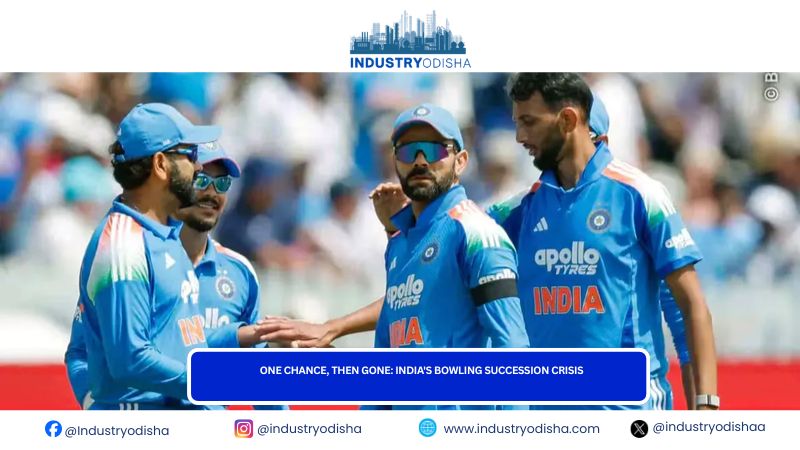
Industry Odisha Bureau, Jul 29: When India names its Test squad for Sri Lanka this month, the familiar pattern emerges again: injury opens a door, a domestic performer walks through it, and the question becomes not whether he’ll establish himself, but how quickly he’ll disappear.
This cycle has calcified into India’s de facto succession strategy, revealing a structural tension that even the world’s deepest bowling attack cannot resolve. The BCCI’s domestic system produces Test-quality fast bowlers with remarkable regularity. What it cannot provide is sustained opportunity a gap that grows more acute as tournament pressure intensifies.
The arithmetic is unforgiving. India’s established pace and spin options Jasprit Bumrah, Mohammed Siraj, Ravindra Jadeja, Kuldeep Yadav, Prasidh Krishna, Washington Sundar remain among international cricket’s most formidable. Each injury to this core group creates a temporary opening, typically filled by someone performing brilliantly in the Ranji Trophy. Once the injured player returns, the door closes. Often it does not reopen.
Akash Deep exemplifies the trap. His record contradicts any suggestion that emerging bowlers lack quality: a 28-wicket haul across his first ten Tests, bookended by a devastating ten-wicket performance at Edgbaston in mid-2025 that secured India’s largest overseas Test victory by runs. Yet he has not bowled in Test cricket since. When India selected him ahead of established names for the South Africa series, they deployed him as an unused passenger across two matches that India lost decisively.
Harshit Rana’s trajectory tells a different story with an identical ending. From a promising November 2024 debut in Perth through two early appearances, he disappeared for eighteen months despite becoming an integral white-ball all-rounder. The selectors recognized his value in limited-overs formats. In Test cricket, where consistency matters most, opportunity never arrived again.
Anshul Kamboj lasted one Test. Mukesh Kumar, drafted as injury cover in 2023, played three matches and vanished within months. Each represents a pattern: a door opening through circumstance rather than planning, closing before the player can establish rhythm.
This contrasts sharply with India’s handling of batting prospects. B Sai Sudharsan weathered three early failures before being recalled and backed consistently thereafter. Karun Nair, returning after an eight-year absence, received multiple series despite modest returns. Batters, it appears, earn extended auditions. Bowlers get auditions.
The World Test Championship’s qualification system intensifies this conservatism. With every match mathematically vital, rotation becomes risky. Selectors face a choice between established names whose underperformance feels acceptable within their track record and emerging talent, whose failure carries outsized cost.
This dynamic does not reflect shortage of quality. Rather, it reveals how tournament pressure transforms selection from succession planning into injury management, converting India’s remarkable domestic production line into what amounts to a bench of temporary replacements awaiting the next vacancy that may never arrive.
