



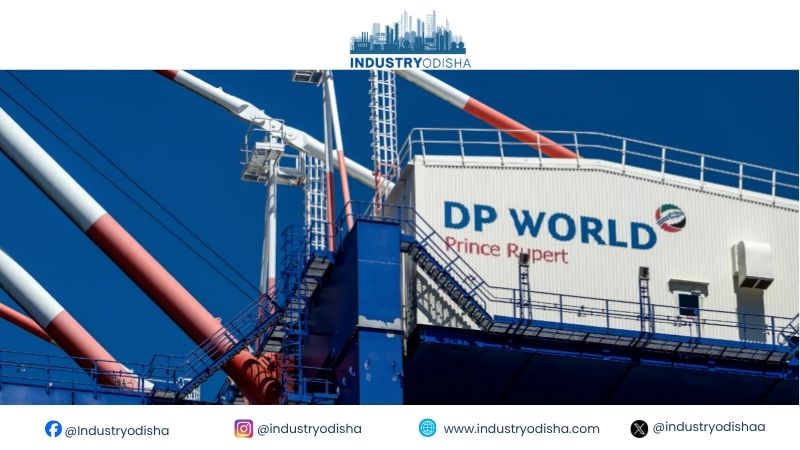
Industry Odisha Bureau, Oct 18: Yuvraj Narayan says fixed 30-year terms leave operators too little time to recover costs. He favours longer joint ventures tied to agreed performance targets. DP World has pledged $5 billion more in India.
DP World Group CEO Yuvraj Narayan has urged India to rethink its port concession model. He argued that fixed-term concessions discourage operators from committing long-term investment. PTI reported his remarks on October 18.
Narayan cited the 30-year concession as an example. He said building a port and stabilising operations can take several years. That leaves a shorter window of high utilisation to recover capital. Repeated tenders and renewals, he added, create further uncertainty.
As an alternative, Narayan proposed long-term joint ventures between governments and private operators. The state would act as landlord and retain ownership of port infrastructure. Operators would be judged against agreed key performance indicators. He suggested such partnerships could continue as long as trust held. The proposal is a commercial argument, not government policy.
Narayan also criticised arrangements combining private investment with revenue-sharing demands and tariff controls. He objected to rival facilities being developed close to existing terminals. Such terms, he said, destroy value for investors.
Indian port concessions vary in length and terms across projects. Longer operating rights could improve certainty but may raise competition concerns. Governments must also weigh public revenue and regulatory oversight. Any joint venture would need enforceable performance standards.
His comments come as DP World expands its Indian ports, rail and logistics network. The Dubai-based company has invested about $3 billion in India over three decades. It has pledged a further $5 billion. Narayan said a further $3 billion to $5 billion could follow as opportunities emerged.
DP World runs five Indian container terminals with combined annual capacity of 6 million TEUs. Its operations span warehousing, freight forwarding and inland rail terminals. The second phase of Nhava Sheva Business Park involves about ₹500 crore.
Narayan said the company’s own ports run at full capacity, unlike parts of the sector. He urged a clearer assessment of existing capacity before further expansion.
DP World is exploring opportunities at Vadhavan port in Maharashtra. The government approved the project in June 2024 at an estimated ₹76,220 crore. It is planned to handle about 23.2 million TEUs. Narayan estimated Vadhavan could require about $10 billion over 10 to 15 years. No operating role for DP World has been confirmed.
Narayan said India should prioritise gateway traffic over transshipment. Gateway ports handle a country’s own imports and exports. Transshipment involves transferring cargo between ships. He argued its gains largely accrue to shipping lines, not the domestic economy. That is his assessment rather than a settled economic consensus.
Narayan pointed to disruption in West Asia. He said restrictions on access to DP World’s Jebel Ali port had disrupted cargo flows. Congestion spread to other parts of its network, he added. Diversifying suppliers and routes raises costs that consumers ultimately bear, he said.
DP World has signed a memorandum of understanding with Cochin Shipyard. It is not a shipbuilder but offers ship repair, dry-dock and engineering expertise.
How India balances investor certainty with public oversight may shape future port investment.
