


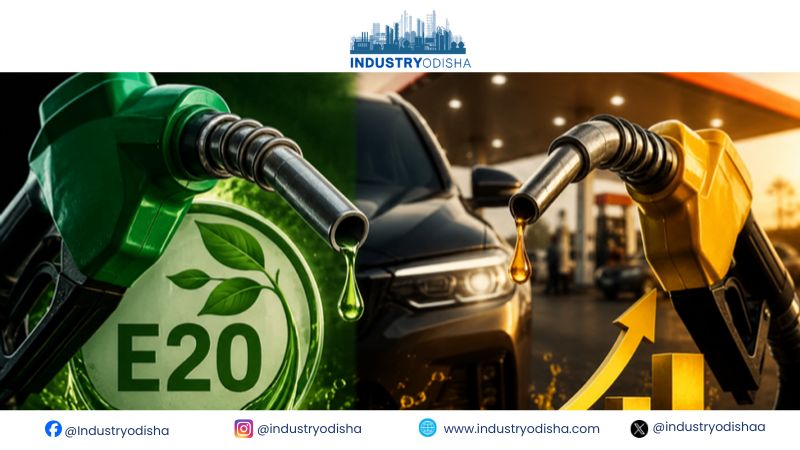
Industry Odisha Bureau, Aug 21: Indian consumers are increasingly purchasing premium, high-octane petrol amid lingering E20 concerns. The shift is notable because premium fuel variants also contain ethanol blending. Consumers are nonetheless paying approximately ₹110–115 per litre for branded premium petrol. Regular E20 petrol costs around ₹102 per litre by comparison. This represents a significant expense increase, yet demand continues rising sharply. Market data shows premium petrol’s sales share reached 12–15% from approximately 4% in March. The buying behaviour reveals deep consumer uncertainty regarding ethanol-blended fuels. Consumers believe higher octane ratings mitigate some perceived E20 concerns. Indian Oil’s XP95, Bharat Petroleum’s SPEED and Hindustan Petroleum’s poWer95 are leading premium brands.
Petroleum dealers report robust increases in premium petrol demand across Indian markets. Delhi-based fuel retailers note that even daily commuters now request premium variants. One retailer stated Octane 95 demand had reached approximately 15% from previous 4–5%. The Federation of All India Petroleum Traders reported Octane 95 represents over 12% of sales. Monty Sehgal, the federation’s spokesperson, confirmed that regular petrol sales declined proportionally. Industry executives expect premium petrol demand to rise further without additional fuel options. Dealers argue that consumers need access to E10 or ethanol-free alternatives.
The appeal of premium petrol reflects broader consumer concerns about vehicle longevity. Motorists worry that ethanol blending affects fuel efficiency and engine durability. They associate higher octane ratings with improved acceleration and engine compatibility. This perception persists despite government claims that E20 is safe. Consumer Voice’s managing trustee noted that vehicles represent significant assets for most consumers. People naturally prefer fuels they believe support better engine performance. Greater fuel options would help address consumer confidence issues surrounding ethanol blending.
Enquiries for Octane 100, an ethanol-free premium fuel, have also increased recently. Octane 100 carries higher additive content compared to standard premium petrol. However, availability remains limited because of supply constraints nationwide. Prices reach approximately ₹160–170 per litre, substantially exceeding premium petrol costs. Retailers estimate Octane 100 represents only approximately 1% of overall petrol sales. Some consumers employ creative strategies, filling half tanks with different fuel types. This unconventional approach reflects frustration about limited fuel options in India.
Diesel vehicle sales have also surged amid this fuel market transformation. Government Vahan data showed diesel car sales jumped to 71,385 units in July. June recorded 64,853 diesel vehicle sales by comparison. This represents a parallel market shift suggesting consumers are exploring multiple fuel alternatives. Rising diesel demand may indicate broader concerns about petrol fuel composition. Oil marketing companies confirmed that premium petrol increases haven’t boosted overall petrol sales.
Consumer organisations have questioned the government’s ethanol-blending policy implementation nationwide. Opposition political parties have raised concerns regarding vehicle fuel efficiency impacts. Kirit Parikh, a former Planning Commission energy member, urged policy clarity. Parikh noted that Indian vehicles may not be engineered for higher ethanol blends. He suggested offering ethanol-blended fuels at cheaper rates to compensate consumers. Electric vehicle promotion would better serve India’s crude oil reduction goals. The government’s chief economic adviser recently proposed reintroducing E10 fuel availability nationally.
The government and state-run oil companies maintain that E20 is completely safe. Officials argue E20 improves vehicle acceleration and reduces harmful emissions significantly. India’s crude oil import bill exceeds $123 billion annually according to government data. Reducing petroleum demand through ethanol blending represents an important energy security strategy. This economic argument forms the core of the government’s ethanol-blending policy.
Extensive testing preceded E20’s nationwide rollout across Indian petroleum distribution networks. Testing organisations included ARAI, SIAM, IOCL, IIP and major automobile manufacturers. Tests covered engine durability, driveability, startability, corrosion resistance, material compatibility and emissions. Government officials stated that no significant abnormal wear resulted from E20 use. The three major oil marketing companies conducted nationwide E20 testing programmes. Results showed chloride contamination levels remained at or below prescribed safety standards. Water ingress and density tests occur 8–12 times daily at retail outlets. Ethanol samples from 80 distilleries recorded chloride levels below 3 parts per million.
The fuel market shift increasingly reflects a tension within Indian energy policy. Ethanol blending serves legitimate crude oil reduction and energy security objectives. However, consumer concerns about vehicle compatibility and fuel efficiency persist stubbornly. Offering consumers greater fuel choice including E10 and ethanol-free options could address confidence gaps. Such changes would require minimal infrastructure modifications at petroleum distribution depots. The debate increasingly centres on balancing energy security with consumer preferences. Future fuel policy may increasingly emphasise choice, transparency and technical validation simultaneously.
