



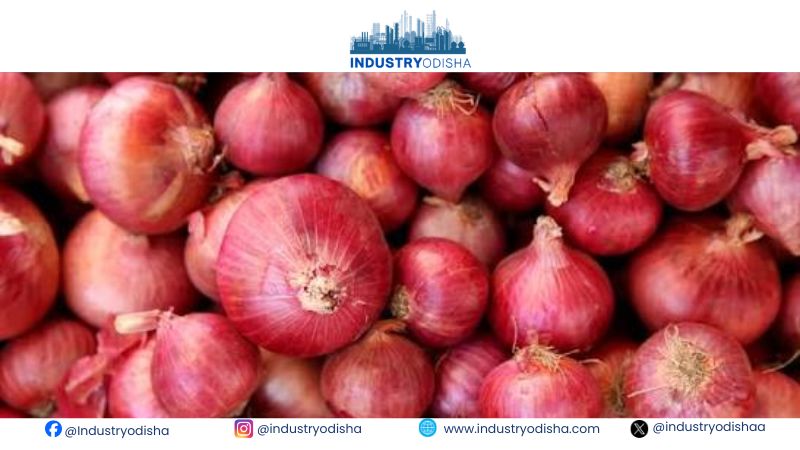
Industry Odisha Bureau, Sep 03: India’s onion market reveals a persistent challenge balancing farmer incomes against consumer affordability. The government banned onion exports from December 2023 to May 2024. Subsequently, the government imposed minimum export prices and varying export duty levels repeatedly. Abnormal rainfall reduced Maharashtra’s kharif crop by five to seven percent significantly. These weather shocks exposed deeper structural weaknesses in India’s onion supply infrastructure critically.
Some Maharashtra farmers sold onions at approximately one rupee per kilogram because of poor quality and inadequate storage capacity. The Centre’s initial procurement price of twelve point three five rupees per kilogram proved insufficient for covering cultivation costs effectively. When the government raised the procurement price to twenty-six point forty-five rupees, many farmers could no longer participate. Their produce had already been sold at distress prices before the policy changed suddenly. This illustrated the limits of government intervention occurring only after market prices collapsed sharply.
Storage represents the most fundamental challenge India’s onion sector faces across the supply chain. Post-harvest losses reached around thirty percent this year, reflecting substantial waste throughout distribution networks. Onions prove more vulnerable to storage losses than wheat or rice during normal handling. The article identifies a critical threshold where post-harvest losses exceeding ten to fifteen percent undermine distribution economics severely. Without significant infrastructure investment, even well-designed government programmes will struggle to function efficiently.
Maharashtra is India’s principal onion supplier, making regional production pressures significant for national availability. Tamil Nadu’s targeted subsidy purchasing one thousand tonnes for distribution at thirty-five rupees represents appropriate consumer protection. However, distributing onions through existing dry-grain systems carries implementation risks requiring careful management consistently. If other States adopt similar measures, the Central buffer could deplete rapidly and unexpectedly.
The government’s repeated changes to export policy create uncertainty that complicates farmer decision-making fundamentally. Policy predictability remains more valuable than short-term price protection for strengthening agricultural productivity. India requires better storage infrastructure, more efficient regional distribution networks and consistent trade policies. Targeted procurement can complement but cannot substitute for structural improvements in supply chains. Stronger onion markets ultimately require coordinated investment across production, storage, distribution and trade frameworks comprehensively.
