



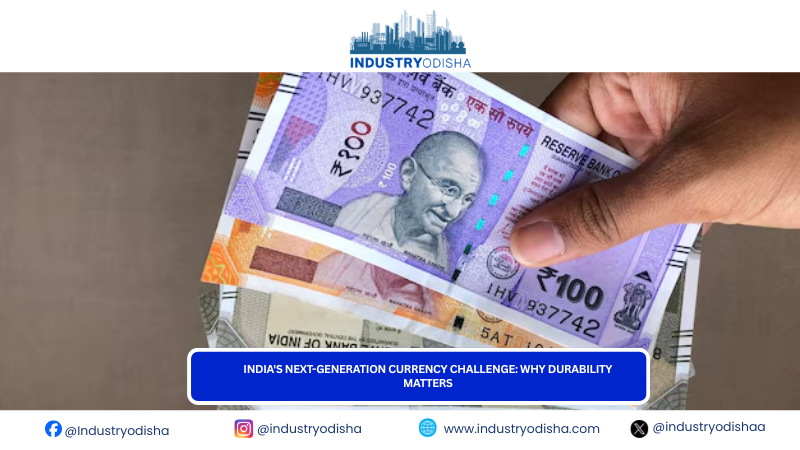
Industry Odisha Bureau, Aug 5: For decades, central banks have treated banknote durability as a peripheral concern a routine operational detail overshadowed by broader monetary policy. But as cash persists in even the world’s fastest-growing digital economies, a quiet revolution is reshaping how sovereign nations approach the physical foundations of their currency systems.
India is joining this shift. The Reserve Bank of India’s planned introduction of polymer banknotes represents far more than a technical upgrade. It signals a deliberate strategy to strengthen the infrastructure that underpins public confidence in cash itself while reducing long-term circulation costs in an economy where billions still rely heavily on physical money for daily commerce.
The operational case for the transition is compelling. Paper banknotes exposed to India’s diverse climatic conditions from coastal humidity to monsoon moisture degrade rapidly. Soiled, torn notes reduce public confidence and complicate logistics for banks and currency distributors. Polymer substrate, by contrast, resists moisture, dirt and wear far more effectively, extending circulation life and reducing the frequency of replacements.
The RBI’s testing protocol reflects this practical reality. Governor Sanjay Malhotra announced during August’s monetary policy review that the central bank intends to begin polymer currency operations by the start of fiscal 2028, following rigorous trials across variable conditions. The initial rollout will target lower denominations ₹10 and ₹20 notes a measured approach that allows the banking system to adapt without wholesale disruption.
Security considerations drive equally important reasoning. The RBI’s note-printing arm has launched a global tender for polymer substrate suppliers, seeking manufacturers capable of embedding advanced anti-counterfeiting features into the new material itself. This represents an evolution beyond conventional surface-level security measures, integrating protection directly into currency composition. Bids close August 18.
The international precedent is established. Australia, Canada, the United Kingdom and New Zealand have successfully operated polymer currencies for decades, providing operational templates and technical evidence.
Critically, India’s approach preserves monetary continuity. Polymer and paper notes will circulate simultaneously through a phased transition, avoiding abrupt market disruption while currency demand gradually shifts toward the more durable option.
This represents intelligent infrastructure thinking: improving the efficiency and resilience of systems that serve India’s unbanked and underbanked millions, even as digital payment networks expand. Long-term durability reduces replacement cycles, lowers environmental impact from destroyed notes, and strengthens public trust in physical currency itself.
The next phase could usefully expand testing across India’s full range of geographic and climatic extremes coastal humidity, riverine regions, and dense urban centers ensuring polymer notes perform reliably in every operating environment before large-scale rollout proceeds.
