


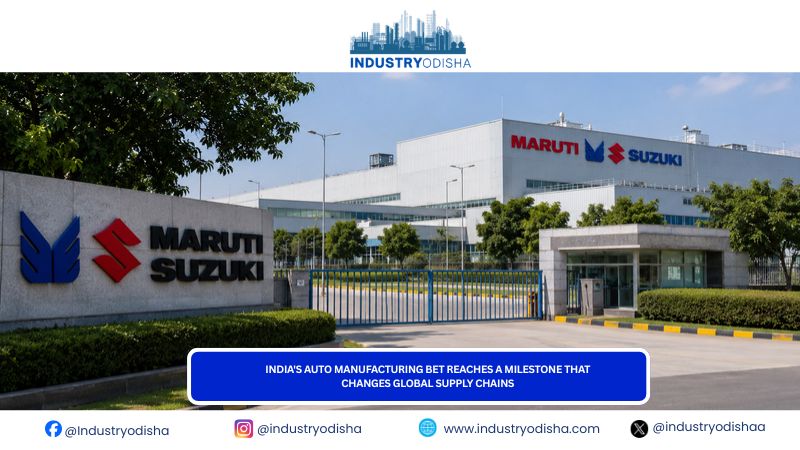
Industry Odisha Bureau, Jul 31: A single factory in Gujarat just crossed a threshold that carries outsized significance for global automobile manufacturing. Maruti Suzuki’s Hansalpur complex has become the first production site under Suzuki’s corporate umbrella anywhere worldwide to reach one million vehicles annually a milestone that underscores India’s accelerating role as a serious competitor in the international automotive supply chain.
The achievement reflects a deliberate industrial strategy. Over the past five years, Maruti Suzuki has invested approximately ₹25.3 billion into the sprawling 640-acre facility, with a fresh ₹3.9 billion committed to its newest production line. That capital deployment has created India’s largest single-location passenger vehicle manufacturing ecosystem, capable of producing diverse models from compact sedans to battery electric vehicles with integrated efficiency.
The composition of that production matters as much as its volume. While Hansalpur manufactures established gasoline-engine models including the Swift and Baleno, its newest assembly line began operations producing the e-Vitara battery electric vehicle a deliberate positioning at the intersection of India’s domestic EV ambitions and global automotive electrification. This architectural choice signals that manufacturers increasingly view India not merely as a low-cost production destination but as a platform for next-generation vehicle development.
Export intensity has become central to Hansalpur’s economics. The facility shipped nearly half of Maruti Suzuki’s international sales in fiscal 2026, transforming Gujarat into a critical node within global automotive supply networks. Combined with the company’s ongoing construction of a parallel facility elsewhere in the state, Maruti Suzuki is positioning itself to achieve production capacity exceeding four million vehicles annually across India a scale that would rank among the continent’s largest automobile manufacturers.
This expansion reflects broader currents reshaping global manufacturing. As companies diversify supply chains beyond traditional automotive hubs and governments prioritize domestic EV capacity, India’s combination of engineering talent, cost competitiveness and expanding infrastructure makes large-scale investment increasingly rational. Whether through employment generation, technology transfer or export capability, Hansalpur’s expansion illustrates how manufacturing is reconfiguring around new geographies.
