



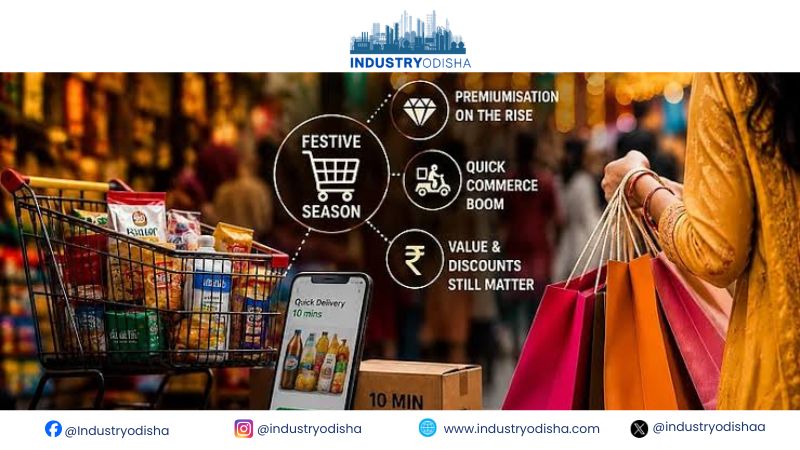
Industry Odisha Bureau, Aug 18: Indian consumers demonstrated resilience during the April-June quarter despite mounting pressures from raw materials. Rural demand, premium products and quick commerce emerged as the strongest growth drivers overall. Retailers benefited from stronger spending momentum, though input costs remain a significant earnings challenge. Companies are now counting on the August-November festival season to sustain consumption growth forward.
The West Asia conflict disrupted crude oil and LPG supplies, forcing companies to increase prices. Demand remained resilient despite these pressures, with companies leaning on premium consumers for volume support. This pattern suggests that consumer spending has strengthened across specific segments rather than uniformly. The recovery highlights both the opportunities and risks facing India’s retail sector in coming quarters.
Hindustan Unilever reported that rural consumption had accelerated significantly over the past few quarters overall. Chief executive Priya Nair described rural demand as the most important recent growth driver for companies. This acceleration represents a shift from earlier patterns when urban consumption dominated retail sector growth. Rural spending gains matter because they indicate broader consumer confidence beyond India’s metropolitan markets today.
Quick commerce emerged as another bright spot during the quarter, defying broader retail uncertainty pressures. Eternal, Zomato’s parent, reported consolidated profit growth of 268 percent year-on-year for the period. Its consolidated profit reached ninety-two crore rupees, a substantial improvement over the previous year. Blinkit contributed 77.5 percent of Eternal’s operating revenue, confirming quick commerce’s continued importance for investors.
Consumer durables benefited from a particularly harsh summer that drove substantial demand for air-conditioners. This category-specific demand demonstrates how weather patterns and seasonal factors continue shaping consumer purchase decisions. Blue Star expects demand to revive from late August into September as festive season approaches. The managing director said the revival will likely occur as the festival season begins officially.
Retailer performance revealed a more complex picture than headline numbers might initially suggest clearly. V-Mart’s net profit increased 40.5 percent, while Trent flagged emerging raw-material inflation and supply-chain risks. Trent owns Zudio and Westside, prominent retailers facing pressure from higher input costs and expenses. Avenue Supermarts experienced a subdued quarter as slower sales at mature stores weighed on results.
Avenue’s management said the 20 percent year-on-year increase in store additions last year may not be feasible in FY27. This signals that rapid expansion may give way to more cautious growth strategies at mature retailers. At Nykaa’s parent FSN E-Commerce Ventures, net profit nearly tripled to 79.7 crore rupees. The recovery in profitability suggests that premium consumer segments remain resilient despite broader economic pressures mounting.
Jewellery demand was hit in May by adhik maas, an inauspicious period for celebrations traditionally. Demand is expected to recover as international tensions ease and the festival season approaches soon. The August-November period extends longer than last year, when most festivals ended by October typically. Companies are launching new products and reshaping portfolios ahead of what they hope strengthens significantly.
The real test now centres on whether stronger consumption can sustain momentum beyond the festival period. Higher input costs remain an important concern for company margins across the retail consumer sector. If raw-material inflation continues accelerating, companies may face difficult choices between volume and profitability targets. Consumer spending has improved, but its durability depends on how companies navigate cost pressures ahead.
