


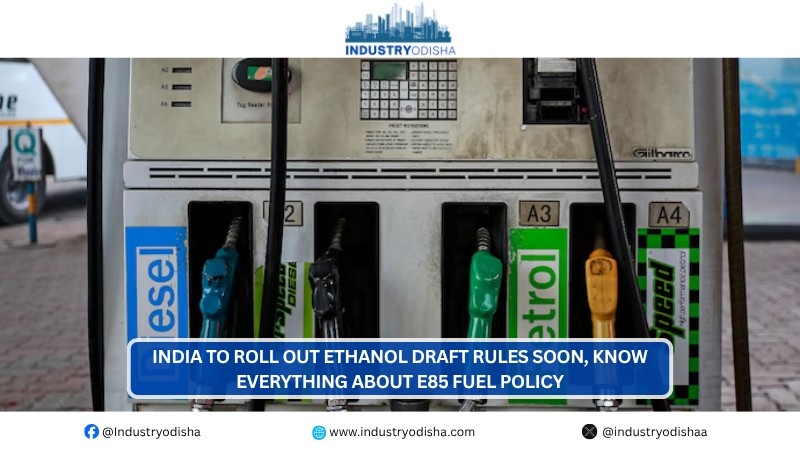
Industry Odisha Bureau, April 22: Being bitten by the bitter experience of acute disruptions of crude oil supply chain and volatility in global oil prices owing to the ongoing Middle East conflict, the Hormuz hurdle and the US Naval blockade, the Government of India (GoI) is reportedly set to issue Draft Rules for E85 – the blending of 85 per cent ethanol and 15 per cent petrol – henceforth to run vehicles on Indian roads.
According to sources, the decision was reportedly “envisaged in 2016”, while it is going to be implemented this time due to the current oil crisis.
It has further been reported that the Draft Rules for E85 will be notified very soon as there is “consensus within the Government and market” as well as “preliminary vehicle testing has also been done”.
Reports also hinted that the “E85 will be launched as a separate fuel category that would be different from the current E20 petrol where ethanol blending can go up to 27 per cent”.
Notably, E20 petrol became mandatory nationwide from April 1 this year (2026).
Reports also elucidated: “E85 would require compatible engines and dedicated dispensing systems at the fuel stations”.
Pertinent to note that, India reportedly targets “One (01) per cent ethanol blending in turbine fuels for international flights under the Net-Zero Goals by 2050”.
It is being claimed that India has ethanol surplus supplies.
Need to mention that: “Ethanol is primarily produced by fermenting plant-based sugars and starches—mostly corn or sugarcane—using yeast. The process involves grinding feedstock, creating a mash, adding enzymes to convert starches into fermentable sugars, fermenting with yeast, and finally distilling and dehydrating the mixture to create high-purity (99%+) ethanol”.
According to AI Overview: “As of late 2025, ethanol, particularly in India’s E20 (20% blend) fuel, is more expensive to procure than base petrol. Although ethanol is sometimes touted as cheaper to produce, the weighted average cost of ethanol (including transportation and taxes) has risen above the pre-tax cost of refined petrol”.
