



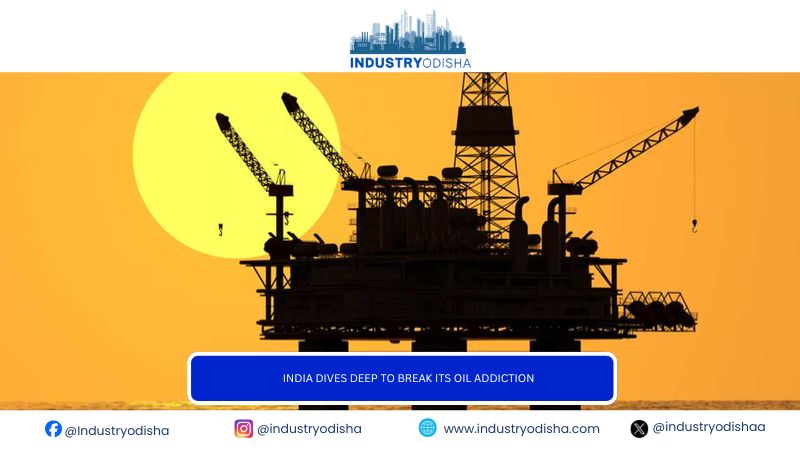
Industry Odisha Bureau, Jul 26: India imported more than 80 percent of its crude oil last year, a dependence that drains foreign exchange and constrains strategic autonomy. On Saturday, the country took a calculated gamble to change that calculus by drilling into some of its most challenging offshore territory and the stakes extend far beyond a single exploratory well.
The Mahanadi Offshore Basin, sitting in water as deep as 3,000 metres off the Odisha coast, holds an estimated 5,600 million metric tonnes of oil equivalent of undiscovered hydrocarbons. That scale rivals major producing nations. Yet extracting those resources requires capabilities India has only recently begun assembling: deepwater drilling expertise, advanced seismic interpretation, and the kind of subsurface knowledge that transforms geological prospects into producing fields.
State-owned ONGC commenced drilling well MN-DW18-1-H-D this week, positioning a drill rig approximately 23 nautical miles from the Konark discovery. The location is no accident. Recent finds at Konark, Utkal, and in neighboring Cauvery and Andaman basins have transformed how Indian geologists view their offshore potential. What once appeared geologically marginal now looks genuinely promising. That shift in outlook prompted Prime Minister Narendra Modi to publicly call for accelerating deepwater exploration during his Independence Day address last August a rare moment when a serving prime minister explicitly champions oil and gas development.
The government responded by opening nearly one million square kilometres of previously restricted acreage for future licensing rounds. That policy move, formally known as the Open Acreage Licensing Policy, signals New Delhi’s willingness to invite private operators alongside ONGC to tackle exploration risk that the state company cannot shoulder alone. Deepwater drilling costs tens of millions of dollars per well. Companies need incentives that extend beyond rhetoric.
To undergird this ambition, ONGC in January established DeepX, a specialized exploration centre in Mumbai designed to marshal the company’s geoscientific talent, advanced computational capabilities, and international partnerships under unified data protocols. The center represents a quiet but consequential modernization acknowledgment that 21st-century oil and gas exploration depends less on drilling luck and more on systematic data integration and predictive modeling.
Whether this well yields commercial quantities remains an open question. Deepwater exploration statistically succeeds only occasionally, and India’s offshore frontier remains immature compared with producing provinces in Brazil, the Gulf of Mexico, or West Africa. Yet the drilling campaign signals a more fundamental shift: India’s acknowledgment that long-term energy security requires not just renewable energy expansion but also systematic domestication of remaining hydrocarbon demand. Every barrel produced domestically is one less dollar spent abroad, one less vulnerability to geopolitical disruption, one concrete step toward the energy self-reliance that New Delhi increasingly views as central to great-power status in an unstable world.
