



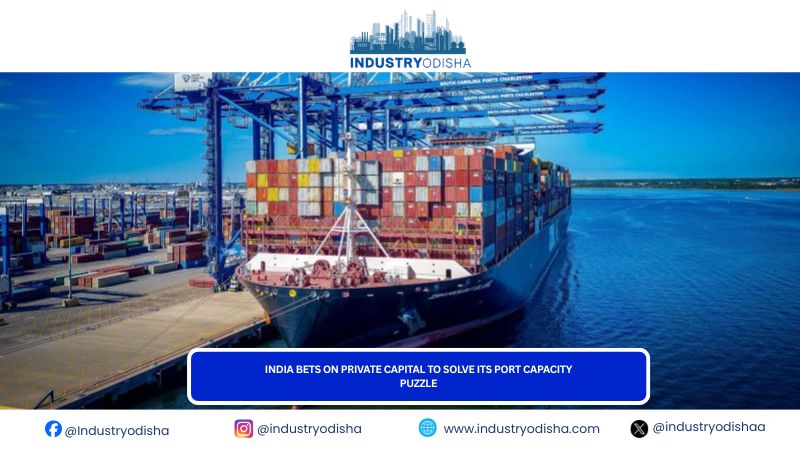
Industry Odisha Bureau, Aug1: India’s ports have become a bottleneck at precisely the wrong moment. As manufacturing shifts eastward and global supply chains reconfigure, the nation’s ability to handle surging cargo volumes will determine whether it can capitalize on its emerging role as a production hub. The government’s overhaul of captive port regulations signals recognition that policy alone cannot close the infrastructure gap private investment must.
The revised framework, approved by the Union Cabinet, replaces a 2016 regime that constrained the economics of port expansion. Under the new arrangement, existing operators gain clearer pathways to enlarge facilities without ceding control to competitors, a shift designed to unlock capital from companies that have long sought greater certainty and operational autonomy.
The policy introduces competitive bidding as the standard mechanism for new projects, but crucially grants current operators a Right of First Refusal. This hybrid approach competition balanced with incumbent advantage aims to attract both existing players confident in expansion and new entrants seeking greenfield opportunities. Crucially, concession agreements can now extend to 30 years, with extensions pegged to market-linked or indexed revenue models, providing investors the long-term visibility required for major capital commitments.
The stakes are substantial. India’s port infrastructure remains fragmented across major and non-major facilities, with disparities in efficiency, technology adoption, and capacity utilization. Port-dependent industries refineries, steel plants, chemical complexes have historically endured constraints on cargo throughput and dwell times. Faster cargo handling, reduced port congestion, and improved connectivity directly translate to lower logistics costs for manufacturers and exporters.
The policy also grants direct waterfront access to eligible government entities where applicable, preserving strategic options for state interests while opening facility expansion to private operators who can deploy capital more dynamically than public entities.
This framework sits within India’s broader maritime development narrative. The Sagarmala programme and PM Gati Shakti National Master Plan have emphasized port-led development and multimodal connectivity. The captive port reform addresses a specific constraint: how to accelerate capacity growth in facilities operated by industrial producers without dismantling the existing investment ecosystem.
Private port operators particularly those with deep expertise in specialized cargo have signaled appetite for expansion under clearer terms. The policy removes several administrative uncertainties that previously discouraged reinvestment. Operators can now project revenue streams across extended concession periods, facilitating debt and equity financing.
India’s export competitiveness increasingly hinges on logistics efficiency. Ports represent critical infrastructure nodes linking production to global markets. By clarifying investment incentives and operational flexibility, the revised policy addresses a foundational constraint on India’s ability to scale manufacturing and export capacity. Whether private capital flows match policy ambitions remains to be seen, but the regulatory framework now tilts decisively toward expansion.
