



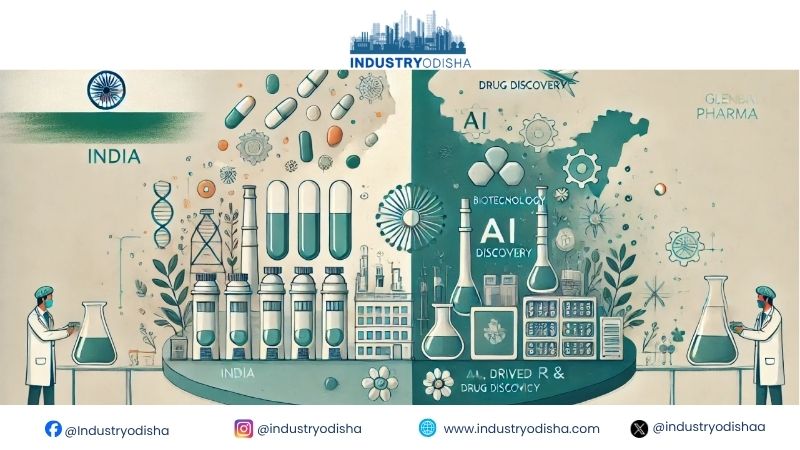
Industry Odisha Bureau, Oct 05: India’s drugmakers built global scale by supplying generic medicines. Industry leaders now want that scale to fund original research. Global success, they argue, needs sustained R&D, credible science and stronger regulation.
For years, the Indian pharmaceutical industry has grown by supplying generic medicines worldwide. That model earned India its label as the “pharmacy of the world”. The question now is whether that scale can finance something riskier.
Three of the sector’s most prominent leaders believe it can. Sun Pharma’s Dilip Shanghvi, Biocon’s Kiran Mazumdar-Shaw and Glenmark’s Glenn Saldanha made the case. They spoke in New Delhi at the Indian Foundation for Quality Management’s symposium. Their shared argument is that scale should now pay for original research.
Scale creates an R&D opportunity
Shanghvi argued that Indian drugmakers have now reached sufficient size. That scale, he said, allows them to invest in innovation and launch products globally. Shanghvi put generics at close to 20 per cent of the global market. Innovative medicines, he said, account for the largest share.
The payoff, however, is slow. The leaders acknowledged that innovation spending delivers returns only after a few years. Shanghvi added that structural government support for innovation could speed the shift.
From manufacturing to intellectual property
Generic medicines largely involve making and selling therapies that already exist. Innovation means creating proprietary drugs and owning the intellectual property behind them.
Mazumdar-Shaw, who joined the event virtually, said India has the necessary scientific talent. It can, she argued, take innovation from the lab to the clinic and market. But that journey requires a credible ecosystem built on quality research and regulatory excellence.
She called generics a major Indian success story. The industry’s next focus, she said, should be intellectual property-led value creation.
China shows the scale of the challenge
Both Mazumdar-Shaw and Saldanha pointed to China. A decade ago, Mazumdar-Shaw noted, China barely featured in pharma or biopharma innovation. Its rise, she said, came from a strategic focus on innovation and credibility.
Saldanha said India now stands roughly where China stood before its rapid advance. The comparison is a benchmark, not a forecast.
Glenmark offers an early example
Saldanha described the coming decade as critical for India’s transition. He cited Glenmark’s recent deal with AbbVie, a global biopharmaceutical major. The licensing agreement covers a cancer drug candidate.
To Saldanha, it shows Indian companies can develop globally competitive therapies. One licensing deal does not prove a sector-wide shift, however.
Regulation must follow research
The leaders also stressed regulatory reform and ecosystem building. They highlighted the need for a strong regulatory framework to speed drug development. In their view, research needs credible institutions to become marketable medicines.
Innovation changes the value proposition
None of this means abandoning generics. Generic manufacturing remains the base that makes larger research bets possible. The aim is adding proprietary medicines and intellectual property on top. That would move Indian drugmakers higher up the pharma value chain.
Shanghvi said innovation could also serve India’s broader economic ambitions. Mazumdar-Shaw argued it could give Indian patients earlier access to therapies for unmet medical needs.
The next pharmaceutical test
India has already proven it can make medicines at global scale. The harder test is turning scientific capability into commercially viable innovation. Research quality, regulation and sustained corporate commitment will matter as much as spending. Whether companies sustain that effort for a decade remains the open question.
