



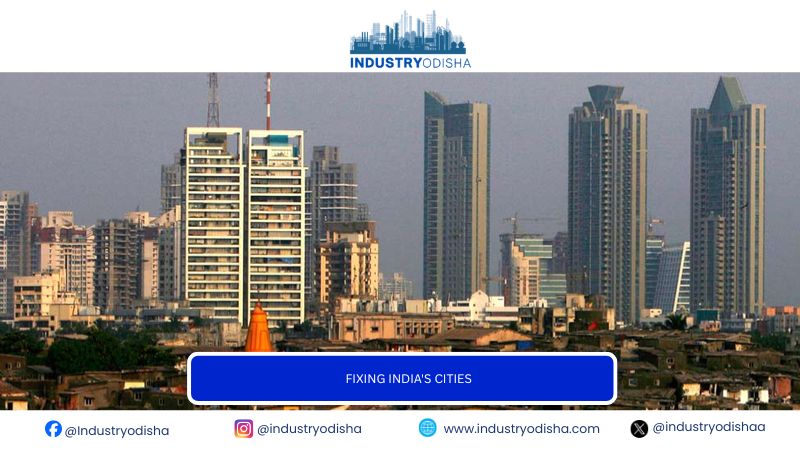
Industry Odisha Bureau, Jul 26: India faces a defining urban test. The nation that constructs world-class airports and expressway networks must simultaneously strengthen the basic municipal systems that serve hundreds of millions of city residents. This dual imperative pursuing global-standard infrastructure while improving everyday civic services will shape the country’s economic growth and global competitiveness for decades.
India’s urbanisation presents a scale challenge unprecedented in human history. Over the next thirty years, the nation will add roughly 200 million urban residents, a figure larger than most countries’ total populations. The World Bank has calculated that meeting infrastructure demands requires hundreds of billions in investment across multiple decades. Yet India’s cities already struggle with systematic service delivery challenges a gap that widens as rural migration accelerates toward secondary and tertiary urban centres where governance capacity remains constrained.
The infrastructure challenges are documented across cities: roads deteriorate during monsoon seasons, water supplies prove inadequate during dry periods, garbage collection systems fall behind accumulating waste, electricity grids experience chronic strain, air quality regularly reaches concerning levels, and open spaces diminish under development pressure. These represent not isolated incidents but persistent patterns repeating across metropolitan areas. Tier-II and Tier-III cities, experiencing the most intense population growth, face these pressures most acutely. Municipal budgets struggle to expand alongside rapid urbanisation; property tax collection remains below potential; cities depend heavily on state government fiscal transfers for resources.
The funding constraint, however, tells only part of the story. India possesses the financial resources as the world’s fourth-largest economy and has demonstrated engineering capability to construct sophisticated infrastructure systems. The difference between what India successfully builds and what it sustains suggests governance represents the deeper challenge.
Municipal administration in India distributes responsibility across multiple institutions. Water boards, electricity agencies, public works departments, development authorities, and municipal corporations each hold partial authority but shared accountability. Institutional fragmentation creates coordination difficulties when separate agencies operate independently. Corruption emerges within this distributed responsibility structure. Contracts frequently follow patronage patterns rather than merit-based selection. Maintenance approaches often emphasize expensive reconstruction over cost-effective preventive work.
This administrative structure carries historical foundations extending to colonial urban planning, which created spatial hierarchies in Indian cities. These patterns persist today through uneven infrastructure investment and service quality across different urban neighbourhoods. Simultaneously, affluent residents increasingly construct self-contained residential enclaves with independent utilities and private services, creating localized functionality amid broader urban service pressures. While this approach addresses individual needs, it reduces collective pressure for universal municipal system improvement.
Technology-focused solutions like smart city initiatives offer efficiency gains, yet digital systems cannot substitute for reliable basic infrastructure. Sensors cannot repair dysfunctional sewage systems. Data analytics cannot replace preventive maintenance protocols. Technology succeeds when basic civic infrastructure functions effectively.
Sustainable urban improvement requires institutional reform: strengthening municipal fiscal autonomy through improved property tax collection, establishing transparent accountability frameworks, professionalizing urban administration, and improving inter-agency coordination. These governance improvements, more than any single infrastructure project, will determine whether India’s cities can sustain rapid urbanisation while maintaining quality of life for all residents.
