



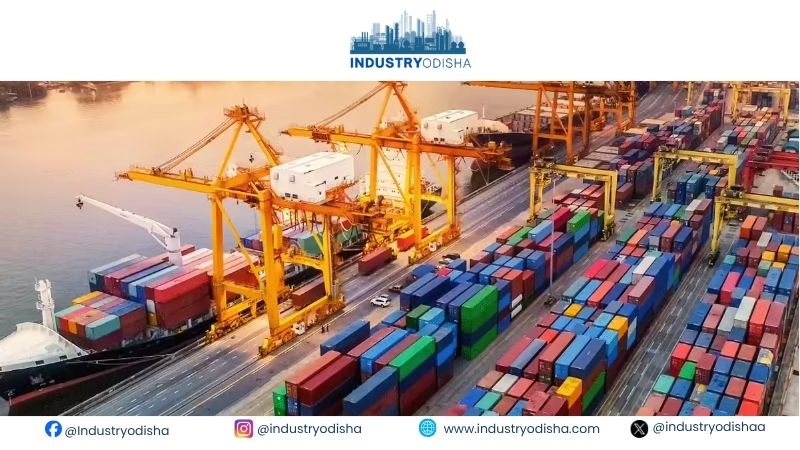
Industry Odisha Bureau, Sep 26: Deendayal, Jawaharlal Nehru, Paradip and Mundra are India’s first designated mega ports. Qualification requires 150 MMT of bulk cargo or 7.5 million TEUs annually. Adani’s Mundra is the lone private entrant; status lasts five years.
India’s port system now has a formal top tier. The Centre has moved to notify four facilities as the country’s first mega ports.
The new status rests on one factor: annual cargo handling scale. Bulk ports qualify at 150 million metric tonnes a year. Container ports qualify at 7.5 million twenty-foot equivalent units annually.
The designation is new to India’s port sector. The move formalises a new benchmark for Indian maritime infrastructure.
Four Indian Ports Enter the Mega Port Category
The Ministry of Ports, Shipping and Waterways listed the ports in a gazette notification. It was issued on Friday.
Three are major ports governed by the central government. They are Deendayal Port, also known as Kandla, and Paradip Port. The third is Jawaharlal Nehru Port, also known as Nhava Sheva.
The fourth is Mundra Port, part of the Adani Group. Mundra is the only privately owned asset on the list.
Cargo Throughput Defines Mega Port Status
The qualifying rules were set out earlier, in a July 30 gazette notification. Friday’s notification then identified the ports meeting those criteria.
The framework uses two separate yardsticks. This reflects the different ways ports handle trade.
Bulk cargo is measured by weight, in million metric tonnes, or MMT. The threshold for bulk ports is 150 MMT of annual cargo throughput.
Container ports are measured differently. Their volumes are counted in twenty-foot equivalent units, or TEUs. A TEU counts container units, not cargo weight. The container threshold is 7.5 million TEUs a year.
The dual structure lets both bulk-focused and container-focused ports qualify. Both thresholds refer to annual throughput, not installed port capacity. Throughput reflects cargo actually handled over a year.
Public Major Ports Meet Private Infrastructure
The initial list spans both public and private ownership. Deendayal, Jawaharlal Nehru and Paradip fall under central government governance.
Mundra, by contrast, is owned by the Adani Group. Its inclusion shows the classification turns on cargo handling scale, not ownership.
A Five-Year Mega Port Classification
The mega port status is valid for five years. It is therefore not a permanent label.
The designation identifies ports that meet defined throughput thresholds. It does not, in itself, add berths, cranes or cargo capacity.
The notification details reported so far do not specify financial or regulatory benefits. Any such advantages cannot be assumed from the designation alone.
Why the Mega Port Tag Matters for Indian Shipping
The classification gives India a common benchmark for its highest-throughput ports. Until now, the sector had no such scale-based nomenclature.
The new tier separates the largest gateways from the wider port network. Both public and private operators can qualify on the same terms. That places maritime infrastructure under a clear, measurable standard.
For port operators, the thresholds now provide a visible benchmark for scale. Future qualification will depend on meeting those cargo handling levels.
For now, four ports, three public and one private, form India’s first mega port group.
