



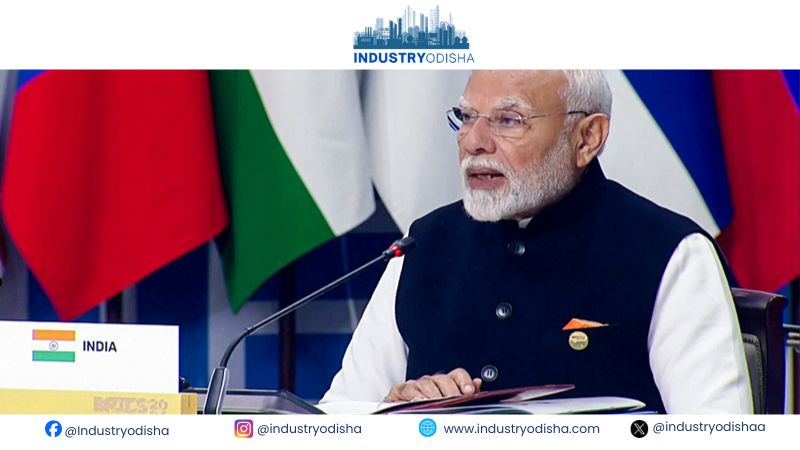
Industry Odisha Bureau, Sep 13: Prime Minister Narendra Modi has cautioned against the weaponisation of technology and critical minerals. He spoke at the BRICS Summit 2026 in New Delhi. Modi said such practices could hinder shared economic progress. He called for greater inclusivity in technology adoption. His remarks place critical minerals firmly on the BRICS agenda.
Critical Minerals Move Up the BRICS Agenda
Critical minerals have become central to global manufacturing and clean energy. China has periodically restricted exports of these minerals and related technologies. These restrictions have raised concerns about supply-chain vulnerabilities. They have also stirred worries about economic coercion. Modi said such weaponisation “can become a hurdle in our shared progress.” He did not name China directly in this context.
Modi-Xi Meeting Adds an India-China Dimension
Chinese President Xi Jinping met Modi on the summit’s sidelines. Their Saturday meeting raised expectations on trade and investment. Rare earth elements and magnet supplies featured among the concerns discussed. However, border tensions between the two countries remain a challenge. No breakthrough or supply agreement has been confirmed.
BRICS Pushes for More Resilient Supply Chains
BRICS leaders adopted the New Delhi Declaration at the summit. It calls for reliable, diversified and resilient mineral supply chains. The declaration also emphasises fairness and benefit-sharing. Resource-rich countries are encouraged to pursue value addition. Sovereign rights over mineral resources are explicitly protected. Modi highlighted the new BRICS Logistics Supply Chain Cooperation Framework. He said it would strengthen supply-chain reliability across the bloc.
Technology Access Becomes a Strategic Priority
BRICS members also backed safer, more secure technology access. Affordability was named as another shared priority. The goal is to strengthen global value chains. Modi linked this push to inclusive and sustainable growth.
Startups and Digital Agriculture Expand Cooperation
India proposed a BRICS Startup Innovation Fund at the summit. The BRICS Incubator Network aims to connect startups region-wide. A new Digital Agriculture Network will link farmers with AI tools. Geospatial technology and digital public infrastructure form part of this push.
Clean Energy and the Global South
A BRICS Digital Centre of Excellence will focus on smart grids. Energy storage is another priority area under this initiative. New centres will also promote agro-ecology and regenerative farming. Modi said these efforts connect traditional knowledge with modern science. He added that Global South trust in BRICS has grown steadily. India wants these initiatives to remain accessible beyond formal BRICS membership.
The Road Ahead
BRICS is now linking resource security with technology cooperation. Diversified supply chains could reduce dependence on single suppliers. Still, converting these commitments into practical outcomes remains the real test. The balance between strategic autonomy and economic cooperation will shape BRICS’s next phase.
