



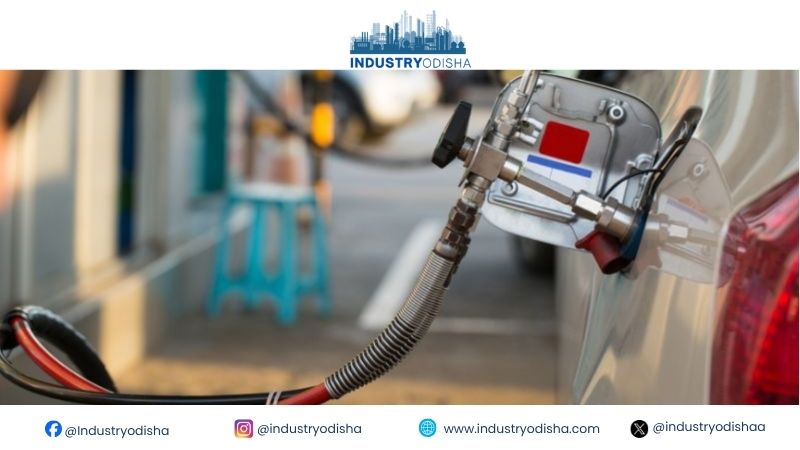
Industry Odisha Bureau, Sep 30: TERI’s lifecycle study gives CNG the lowest environmental burden in most vehicle categories. India’s coal-heavy power mix weighs on EVs, despite zero tailpipe emissions. Yet electric two- and three-wheelers remain the preferred choice.
Beyond the Tailpipe
An electric vehicle emits nothing from its exhaust. That single fact has long anchored the case for electric mobility in India. A new study from The Energy and Resources Institute (TERI) takes a wider view. It measures a vehicle’s environmental burden across its entire life cycle. On that basis, CNG shows the lowest overall burden in most categories. The finding holds under India’s current electricity mix. It is not a verdict against EVs.
What a Lifecycle Test Measures
Lifecycle assessment tracks impacts from start to finish. It covers fuel or power production, vehicle manufacturing, operation and disposal. TERI weighed climate change, particulate matter and human toxicity. It also counted water use, fossil-resource use, and minerals and metals consumed. Tailpipe emissions, in this framework, are only one stage of the footprint.
Coal Changes the Equation
The electricity mix is the pivotal variable. TERI describes India’s power generation as predominantly coal-dependent. Charging an EV therefore carries upstream impacts from that grid. Battery manufacturing adds a further environmental load.
Yet EVs hold a clear edge on operational air pollution. They produce no tailpipe emissions, unlike petrol, diesel or CNG vehicles. TERI says their lifecycle score is sensitive to power sources and batteries.
Different Vehicles, Different Answers
The segment findings are more nuanced than the headline result. EVs already offer the lowest ownership costs for two- and three-wheelers. Lower running costs and high utilisation drive that advantage. Electric mobility emerges as the preferred option for these segments. It also suits certain urban mobility applications.
The picture shifts for larger vehicles. For passenger cars, taxis, buses and light commercial vehicles, CNG currently offers a stronger balance. That balance spans economic, environmental and operational factors. Charging needs, payload limits and battery impacts weigh more heavily as vehicles grow.
Freight Needs Its Own Route
Heavy-duty transport gets a differentiated pathway. CNG is expected to stay relevant for regional freight. LNG could gain ground in long-haul trucking. Battery-electric trucks remain suitable for select applications under the conditions assessed.
From Oil Imports to Mineral Supply Chains
TERI also flags an energy-security trade-off. Electrification can reduce India’s direct dependence on imported crude oil. But it can raise exposure to global supply chains for battery minerals. Lithium, cobalt, nickel and graphite are key battery materials. That makes supply-chain resilience a central concern as the EV ecosystem grows.
Policy Push Continues
The findings arrive as India expands EV adoption through incentives. The PM E-DRIVE scheme provides incentives to promote EV uptake. It has also earmarked ₹2,000 crore for public charging stations. Support for domestic manufacturing forms another pillar of the transition. TERI’s work suggests the environmental case varies by segment and power source.
No Universal Powertrain
The study compared petrol, diesel, CNG, electricity and LNG across six vehicle categories. It weighed technical, environmental, economic, social and geopolitical factors. It also projected outcomes for 2030, 2040 and 2050.
Its core conclusion is that no fuel wins everywhere. No single powertrain performs best across every category and criterion. India’s transport decarbonisation may therefore need several routes, not one. CNG’s lifecycle edge, as TERI frames it, reflects today’s power mix.
