



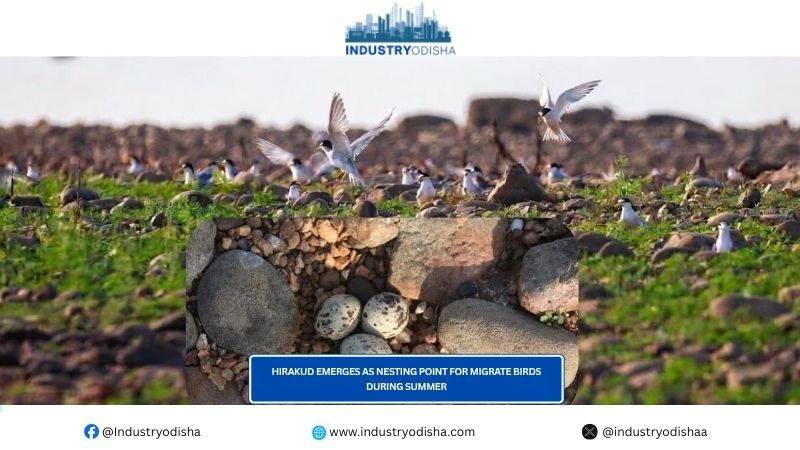
Industry Odisha Bureau, Jun 15: Hirakud Wetland, a Ramsar Site, has slowly emerging as a nesting destination for migratory birds during summer season. Hirakud Wetland was systematically surveyed for the first time in May 2025 and has been assessed again during June 2026. Some winter migratory species have remained in the wetland through the summer months instead of undertaking their usual return migration, resulting in an increase in breeding activity across the landscape, said Anshu Pragyan Das, DFO, Hirakud wildlife division.
The Hirakud Wetland and adjoining habitats have witnessed a significant improvement in summer bird breeding during 2026. A total of 19 species have been recorded nesting this year, compared to 10 species during the summer of 2025, she said.
Das said nesting activity has also expanded spatially, with breeding colonies documented on 28 islands in 2026, against 26 islands in 2025. Two additional islands, Tupa Dungri and Bhalu Dunguri, recorded nesting for the first time.
Conservation efforts during the breeding season have focused on safeguarding both nesting sites and the ecological conditions necessary for successful rearing of chicks.
Summer nesting in the Hirakud Wetland and adjoining habitats has been successfully conserved through protection of breeding habitats, maintenance of favourable ecological conditions, minimization of human disturbance, regulation of fishing activities, prevention of pollution and fires, active monitoring of nesting colonies, and strong community participation, the DFO informed.
The sustained efforts of the Forest Department and local communities have helped maintain a disturbance-free wetland ecosystem throughout the breeding season, enabling birds to successfully complete nesting and raise their young, she added.
The increase in both the number of nesting species and the spatial extent of breeding colonies reflects the improving ecological health of the Hirakud Wetland and highlights the importance of continued conservation measures in this internationally significant Ramsar landscape.
Protection of Nesting Habitats
Natural nesting habitats comprising reed beds, grasses, shrubs and trees have been protected, while disturbance-causing activities such as vegetation cutting during the breeding season have been discouraged. Natural islands and shallow marshes preferred by breeding waterbirds have been maintained.
Maintenance of Suitable Water Regime
Stable water levels, aided by the Hirakud Dam, have provided favourable conditions during the breeding period. Along the shorelines, particularly in villages situated towards both ends of Debrigarh Wildlife Sanctuary, natural pools and mudflats have been retained to provide feeding grounds for adult birds and chicks.
Minimization of Human Disturbance
Fishing activities, boat movement and livestock grazing have been regulated in and around breeding colonies. Since nesting commenced in mid-April, fishing has been restricted around all 28 nesting islands, and seasonal “no-entry” zones have been enforced for fishermen as well as patrolling boats around important breeding sites.
Management of Predators and Invasive Species
Feral dogs have been monitored and managed wherever necessary. Efforts have also been undertaken to remove invasive and toxic plant species that adversely affect the natural vegetation structure of the wetland.
Pollution Prevention and Community Sensitization
More than 100 villages surrounding Hirakud and Debrigarh have been sensitized over the past three years regarding prevention of pollution and prohibition of waste and sewage disposal into the wetland ecosystem.
Under the dedicated “Debrigarh Abhinandan” programme, awareness campaigns have been conducted through all Eco-Development Committees (EDCs) to promote good sanitation practices and discourage open defecation and the disposal of non-biodegradable waste. More than 20 important villages adjoining Hirakud have been provided with adequate dustbins. Improved water quality is expected to support aquatic biodiversity and enhance fish productivity.
Ensuring Food Availability
Habitat management interventions have been undertaken throughout the year to conserve native fish, amphibians, insects and aquatic vegetation, thereby ensuring adequate food resources for both migratory and resident bird species and promoting successful breeding.
Monitoring of Breeding Colonies
Round-the-clock monitoring of breeding colonies is being carried out by river patrolling teams. Continuous surveys of islands and nesting sites, including assessment of fledgling success, are being undertaken. The breeding season for both migratory and resident species commenced in mid-April and is expected to continue until the end of July.
Awareness and Community Participation
Local communities have actively participated in protecting vulnerable nesting sites from tree felling and accidental fires, thereby strengthening conservation efforts across the landscape.
Zero Summer Fire Initiative
To prevent habitat loss, fire lines have been established around reed beds and grasslands. Awareness programmes in surrounding villages have discouraged the earlier practice of burning grasslands adjoining agricultural fields, as such fires are known to encourage weed growth and pest infestation. Controlled burning has been advised to remain confined to agricultural fields. Consequently, the landscape has remained free from summer fires affecting critical bird habitats.
