



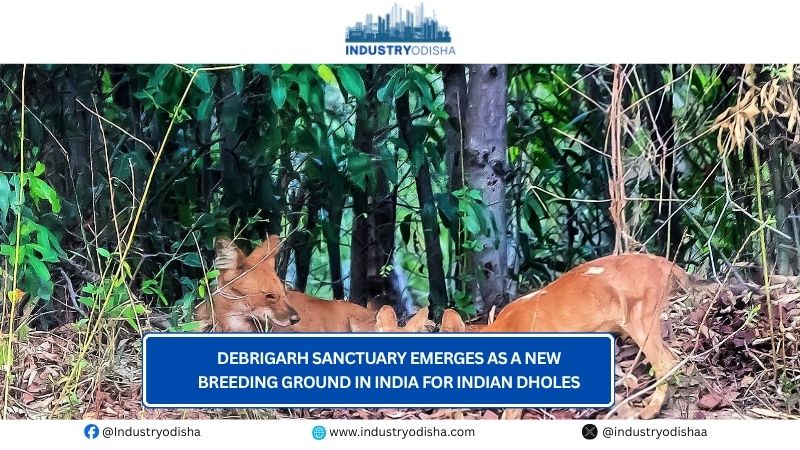
Industry Odisha Bureau, May 16: Odisha’s Debrigarh Sanctuary emerges as a new breeding ground in India for the rare & endangered “Indian Dholes” (Asiatic Wild Dogs or Balua Kukura in Odia), officials said on Saturday. Debrigarh Wildlife Sanctuary has recorded a significant conservation gain with successful breeding of Dholes and the sighting of a litter with two pups.
Breeding has been observed in the pair that has gradually established movement within the Sanctuary over the past two years, said Anshu Pragyan Das, DFO Hirakud wildlife division.
The birth of the pups indicates favourable habitat conditions, ensured protection, adequate prey availability and ecological security within the landscape, she said.
Sanctuary authorities are closely monitoring the movement of the mother with the pups while ensuring minimal disturbance.
In Debrigarh Sanctuary, a lone Indian Dhole was first camera trapped moving inside the Sanctuary during October’ 2023, a rare and significant observation for the landscape.
Sometime later, another wild dog was seen accompanying the first, and gradually the pair began moving together across the grasslands & hills of the Sanctuary covering more than 100 Sq km area for more than two years until beginning of 2026 when their movement gradually became confined to a smaller area of the Core during female’s advanced stage of gestation, she said.
During third week of May the mother was first time recorded moving with a pair of litter (3 to 4 months old), pups were camera trapped while moving on the footpaths.
Following the sighting of the Dhole pair with two pups, 26 Camera traps have been strategically placed to record their movement.
A deer kill was also recorded within their resting area indicating active hunting ability. These observations may mark the early foundation of a future pack and signals the ecological suitability of Debrigarh for the return of this endangered carnivore, the DFO said.
Interestingly, she pointed out, the Dhole pair in Debrigarh Sanctuary was observed breeding even without the presence of a larger pack, slightly uncommon but remarkable sign of adaptation and survival.
The pair has now been seen with a litter of two pups, indicating successful breeding within the sanctuary, protection and monitoring measures have been strengthened in & around the Sanctuary to zero down disturbance around the breeding area.
Movement near waterbodies, saltlick is being carefully regulated, while frontline staff are maintaining regular surveillance to ensure the safety of the mother and pups.
Efforts are also focused on maintaining a healthy prey base and reducing potential threats from feral dogs, disease transmission, or human interference in the bordering areas to secure the Core.
Such precautionary measures are crucial during the early stages of pup rearing, when the survival of the litter is most vulnerable as they are yet to learn survival skills in the forest with other predators, Das informed.
The mother Dhole is observed to care of the pups. It appears from CT pics that the pups are until now dependent on mother for warmth and milk,and moving with the mother mostly. Breeding & birth of a litter with two pups is a hopeful sign for the continuity of this highly endangered predator.
The arrival of pups not only reflects successful breeding but also indicates a healthy prey base and secure habitat, both essential for the survival of these remarkable hunters.
Where the first one dispersed from, and from where the second eventually joined it, still remains one of the forest’s intriguing mysteries.
Dholes are known to travel long distances in search of territory, mates, and prey, often silently reconnecting fragmented landscapes through their movement. During the year 2022 & 2023, two new Checkgates were strategically placed ( total 12 antipoaching checkgates) at Debrigarh Sanctuary to further strengthen protection measures and secure an effective inviolate habitat of approximately 300 sq.km within the Sanctuary, providing a disturbance-free breeding landscape for wildlife.
All border checkgates are under CCTV surveillance 24/7 with manned protection to ensure continuous monitoring & effective enforcement.
India is known to have around 1000 to 2500 Wild Dogs mostly occupying Western Ghats, Central Indian Forests & Northeast India.
