



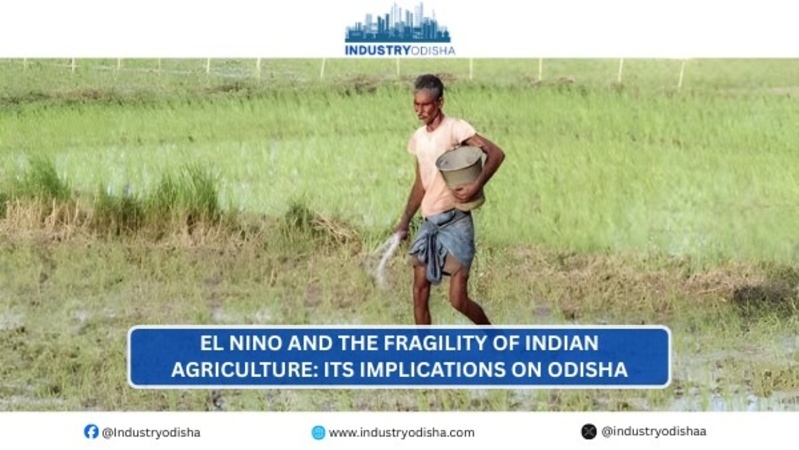
Indian agricultural sector is likely to face a challenging year ahead amid concerns over weak monsoon, possible El Nino conditions and fertiliser supply risks linked to the West Asia conflict, according to a report by ICRA.
The south-west monsoon, responsible for watering most of India’s farmlands, may be just 92% of its 50-year average this year, the India Meteorological Department (IMD) said, with 96-104% considered normal.
What is El Nino
El Nino is a natural climate phenomenon where the surface waters of the central and eastern Pacific Ocean become unusually warm every two-seven year. In simple words, it’s like the Pacific Ocean “heating up,” which disrupts normal wind and weather patterns across the world.
Though this phenomenon unfolds thousands of kilometres away, its consequences are felt most acutely in the country’s farms, where the success of a season still hinges on the rhythm of the monsoon.
How it has affected India’s crops in the past
It has a disproportionate influence on India’s agricultural destiny by weakening and destabilising the monsoon. For example, major El Nino years such as 2002, 2009 and 2015-16 saw rainfall deficits, leading to droughts and reduced crop yields. Kharif crops such as rice, pulses, and oilseeds suffered due to delayed sowing and moisture stress, while erratic rainfall damaged standing crops. Foodgrain output declined, triggering food inflation and rural distress. Although impacts vary regionally, the overall effect has been increased uncertainty in farming, exposing the vulnerability of India’s monsoon-dependent agricultural system and its broader economic consequences.
Most importantly, its increasing unpredictability has been the real danger, apart from reduced rainfall. El Nino disrupts the temporal distribution of rain, leading to prolonged dry spells interspersed with short bursts of intense precipitation. This volatility erodes the reliability that farmers depend on, making agricultural planning more uncertain than ever.
Implications for Odisha
Odisha, one of the states, which is heavily dependent on agriculture, has been projected to receive below normal rains by the IMD in its long-range forecast for monsoon season.
The state, which normally receives 209.3 mm rainfall in June, 341.4 mm in July, 363.8 mm in August and 235.7 mm in September, is likely to witness below- normal rains up to 35% to 45% during this season, claim reports. Last year, the state recorded 1,150.9 mm rain against its average of 1,150 mm.
Though the state has not recorded deficit rainfall during monsoons since 2000, at first glance, it appears less exposed to the classical El Nino effect, leading to a perception that Odisha is relatively insulated from its worst impacts.
But then, the state’s vulnerability lies not in aggregate rainfall figures but in its agricultural structure. Odisha’s farming economy is heavily dependent on paddy cultivation, much of it sustained by monsoon rain rather than assured irrigation. Even slight delays in the onset of rain can disrupt transplantation cycles, while extended dry spells can reduce yields. For small and marginal farmers, who form the backbone of Odisha’s agrarian economy, there is little margin for error.
Moreover, frequent extreme weather adds to the woes causing flooding, damaging crops and degrading soil, fuelled by short, intense rain spells. Odisha, therefore, faces a double risk—dry spells followed by sudden excess rain.
The impact can go beyond farms. While uncertain crop output can lead to price volatility, it may also push up food costs for both rural and urban consumers. For a state heavily dependent on agriculture, this means unstable incomes and weaker economic activity.
The way forward
First, diversification must become central to agricultural strategy. The continued dominance of water-intensive paddy makes the system inherently fragile. Promoting crops that are resilient to climate vulnerability, such as millets, pulses, and oilseeds, can reduce risk while enhancing nutritional security.
Second, irrigation reform is critical. Expanding micro-irrigation and improving water-use efficiency can help farmers cope with erratic rainfall. Odisha’s network of rivers and its coastal geography offer untapped potential for building decentralised irrigation systems that are both adaptive and sustainable.
Third, climate-resilient agriculture must move from policy rhetoric to field-level implementation. This includes developing and distributing seed varieties that can withstand droughts as well as waterlogging, strengthening extension services, and providing farmers with real-time weather information.
Finally, institutional innovation is key. Localised climate intelligence systems, combining meteorological data with advisory services, can empower farmers to make informed decisions on sowing, irrigation, and harvesting. Such systems can reduce uncertainty, which is often the most damaging consequence of climate variability.
El Nino is no longer an occasional disruption—it is a recurring stress test for India’s agriculture. For Odisha, the risk is not just less rain, but unpredictable rain. Unless policy shifts from reactive relief to climate resilience, every such cycle will deepen farm distress.
Also Read : – Is India Proactively Investing To Meet Environmental Goals ?
