



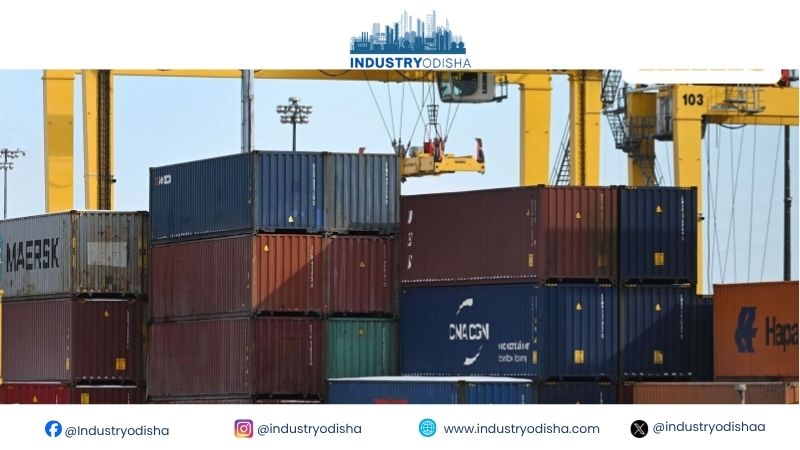
Industry Odisha Bureau, Oct 30: India wants its own shipping container industry, and it is paying to build one. The Union Cabinet cleared a ₹10,000-crore support programme on 28 October. It targets annual capacity of 7.5 lakh TEUs by FY40, up from 70,000. One TEU, or twenty-foot equivalent unit, equals a standard 20-foot steel box. That is a more than tenfold jump in just 13 years.
The scheme mainly tackles running costs, where new Indian makers trail Chinese rivals. About ₹8,891 crore, nearly 90% of the outlay, will reward actual production. Makers will get ₹49,500 for each 20-foot box and ₹86,625 for each 40-foot one. Specialised 20-foot units will earn between ₹37,125 and ₹74,250 apiece. A further ₹859 crore will subsidise interest on capital loans. Another ₹150 crore will fund testing and certification. Concessional port lease rates will also ease land costs. The three listed allocations total ₹9,900 crore; the balance is not itemised. An earlier ₹11,000-crore incentive plan was under consideration in FY24, Mint reported.
The scale of China’s lead explains the urgency. China made over 97% of the world’s containers in FY26, against India’s 0.5%. Those shares come from the National Shipping Board’s FY26 annual report. China’s industry association says the country produced about 6.45 million TEUs in 2025. Its factories sit in clusters near steel mills, keeping input costs low. China is the top steel producer and, per WTO data, exported $3.77 trillion in 2025. Decades of ties with shipping lines lock in its customers.
Minister Ashwini Vaishnaw wants India to hold 15–20% of global production by FY40. The arithmetic does not yet line up. At current global volumes, 7.5 lakh TEUs would be roughly an 11% share. Installed capacity is also not output, and output is not market share. Reaching 15% would need more capacity, unless global output shrinks.
Supply security is the scheme’s strongest argument. In April’s West Asia war, mango exporters ran short of refrigerated containers. They paid for costlier options as freight rates rose too. Shankar Shinde of Global Express Multilogistics told Mint local production would reduce shortage risks. He noted Indian-made boxes could also carry domestic freight, unlike imported ones. Still, building boxes does not guarantee exporters will get them. Shipping lines and lessors own most containers and move them wherever demand pays. Domestic output may not, on its own, cut freight rates.
Steelmakers gain directly, along with suppliers of corner castings, wooden floors and paints. Ports at Vadhavan and Galathea Bay could add demand as trade grows. The government projects 3,000 direct and over 50,000 indirect jobs. It also expects ₹75,000 crore of economic output by FY40. These are estimates, and gross output is neither tax revenue nor profit.
Subsidies can build factories, but only customers can keep them running. The real tests are output volumes, utilisation, export orders and unit costs. Orders from global lessors and shipping lines will matter most. If Indian boxes compete once support fades, the bet pays off.
