



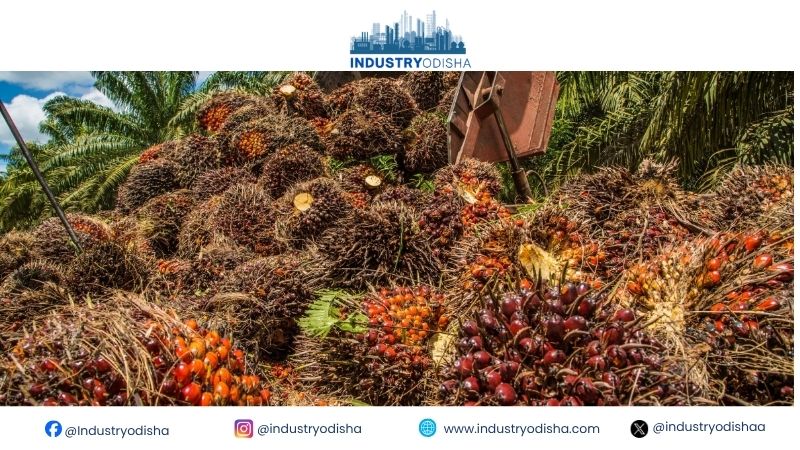
Industry Odisha Bureau, Oct 27: India spends billions importing edible oil, with palm oil the biggest share. An ₹11,040-crore mission now has farmers betting on a 20-year crop to change that.
India’s kitchens run on imported oil. The country consumes about 26 million tonnes of edible oil a year, Mint reports. Imports cover roughly 16–17 million tonnes of that. Palm oil is the largest single component. In 2024–25, India spent about $18.3 billion on vegetable oil imports. The figures come from the Solvent Extractors’ Association of India (SEA), an industry body.
Supplies come from a handful of countries. Palm oil arrives from Indonesia and Malaysia. Soybean oil comes from Argentina and Brazil, and sunflower oil from Ukraine and Russia. That leaves India exposed to foreign prices, currency swings and supply shocks.
Now a silent shift is under way in parts of rural India. Farmers are betting on oil palm, a tree that yields for about two decades. Their choices will help decide whether India’s ₹11,040-crore palm oil mission succeeds.
A second yellow revolution
India has tried this before. The first Yellow Revolution began in 1986–87. It targeted nine oilseed crops, including mustard, groundnut, soybean and sunflower. Their combined output was 12.6 million tonnes at launch. Mint puts it at an estimated 43.06 million tonnes in 2025–26. These are oilseed volumes, not oil. Yet demand from a growing population and food industry raced further ahead.
The new push centres on oil palm for one reason: yield. Under ideal conditions, a hectare can produce 20–25 tonnes of fresh fruit bunches. That translates into 4–5 tonnes of palm oil and half a tonne of kernel oil. Mint reports that is nearly five times traditional oilseeds such as mustard and groundnut. Those are ideal-case numbers. Actual Indian yields average about 2.4 tonnes per hectare, a recent white paper notes.
The mission and its mechanics
The National Mission on Edible Oils–Oil Palm (NMEO-OP) began in August 2021. Its total outlay is ₹11,040 crore. Its headline goal was adding 6.5 lakh hectares to reach 10 lakh hectares by 2025–26.
Progress has been real but partial. Mint reports nearly 300,000 hectares shifted to oil palm in five years. The expansion spans 15 states. Official data shows 2.73 lakh hectares added by March 31, 2026. That took India’s total oil palm area to 6.40 lakh hectares. That is well short of the 10-lakh-hectare goal.
Spending tells a similar story. Central allocation for 2021–22 to 2025–26 was ₹4,050.56 crore. Of ₹1,490.25 crore released, ₹1,196.60 crore had been spent by March 2026. The gap shows a headline allocation is not the same as money spent. The mission continues, with 2026–27 state action plans approved at ₹1,143.9 crore.
The government’s broader targets are ambitious. It wants domestic edible oil output of 25.45 million tonnes by 2030–31, Mint reports. That would meet roughly 72% of projected demand. Within that, crude palm oil output is targeted at 2.8 million tonnes. Actual crude palm oil production was 3.80 lakh tonnes in 2024–25, the Centre said. By that measure, the target requires output to rise more than sevenfold.
How farmers are protected
For farmers, the core attraction is price assurance. The Centre uses two prices. A monthly formula price tracks the market. An annual viability price is fixed by the Centre. If the formula price falls below the viability price, farmers get the difference. The payment goes directly into their bank accounts.
Farmers also receive free high-yield seedlings and training in good practices. Processors get support to set up mills. The Centre bears a larger share of mill costs in the North-East. The same applies to the Andaman and Nicobar Islands. A government official told Mint the mission runs through over 600 value-chain clusters. Farmer producer organisations and cooperatives manage many of them.
The farmer’s arithmetic
Oil palm demands patience. Trees take three to four years to bear fruit. Farmers must get through that period without income from the main crop.
Kishor Yelati of Chintampalle village in Eluru district shows how. He planted about 4.8 hectares of family land. He grew maize for two years, then groundnut in the third. Today he grows cocoa between his palms. Mint puts his earnings at ₹1.2–1.7 lakh a hectare, a figure excluding expenses.
In East Godavari, Gopal Krishna Reddy farms 24.3 hectares of oil palm. He earns over ₹1.2 lakh a hectare, according to Mint. He bridged the gestation years with maize and vegetables. Reddy estimates around 4,050 hectares in his district moved to oil palm in five years.
These are individual cases, not national averages. Earnings depend on yields, prices, irrigation and distance to a mill. Gross receipts are not the same as net profit. And a 20-year tree locks land into one crop for a long time.
Where the crop is growing
Andhra Pradesh dominates. It produces roughly 83% of India’s crude palm oil, Mint reports. It added 30,364 hectares in 2025–26, with Eluru alone contributing about 12,140. Telangana added around 12,000 hectares. Together they drove most of the 52,113-hectare national addition that year. One industry report put Andhra’s addition far lower, at 13,286 hectares. The difference may reflect timing or coverage, and remains unexplained.
The two states share key advantages. They have assured rainfall or groundwater in coastal and irrigated belts. They treat oil palm as a horticulture priority. Mills sit close to plantations. And many farmers have two or three decades of experience with the crop.
The North-East is the new frontier. Assam, Tripura, Manipur, Nagaland and Arunachal Pradesh have begun large plantation programmes. Assam alone has set a target of 375,000 hectares. That is a goal, not yet an achievement.
Private capital and the mill problem
Processing is the sector’s hardest constraint. Fresh fruit bunches start losing oil quality within about 24 hours of harvest. Every plantation therefore needs a mill nearby. Mills are expensive and slow to build, while plantations produce for decades. Getting that sequencing wrong can leave farmers with fruit and no buyer. The mission has approved 24 mills with about 638.5 tonnes per hour of capacity.
Godrej Agrovet is India’s largest oil palm processor. Its footprint covers roughly 80,000 hectares, and it targets about 150,000. CEO Sunil Kataria told Mint the company added nearly 17,000 hectares last year. Its new integrated complex in Khammam, Telangana, combines genetics, a nursery, research and milling. A refinery is also planned there. Total investment will be about ₹300 crore when fully operational, Mint reports.
Patanjali Foods has set a 500,000-hectare plantation target for 2030, CEO Sanjeev Asthana said. The company says it covered over 110,000 hectares, involving 80,000 farmers, by 2025–26. It has built 53 nurseries, plus collection centres and procurement points. It has also introduced telescopic poles that let workers harvest bunches from the ground. Godavari farmer R. Krishna Reddy told Mint the pole saves labour and time.
These are company targets and disclosures, not independently verified figures. Over three dozen other private players are also involved, including 3F Oil Palm.
Yield, water and sustainability
Raising yields matters more than adding hectares. A white paper sets out a pathway to higher output. Solidaridad Asia, SEA and the Asian Palm Oil Alliance co-wrote it. It proposes lifting yields from about 2.4 tonnes to 4–5 tonnes per hectare. It calls for better planting material, training, irrigation, fertilisation and pest control. It also suggests repurposing low-return farmland. Its roadmap targets up to 50% palm oil self-sufficiency by 2047. That is a modelled ambition, not a forecast.
Sustainability questions also need answers. Oil palm is a thirsty crop, which is why irrigated belts dominate. Expansion into new regions must avoid damaging forests and biodiversity. Poorly managed land-use change could undercut the mission’s credibility. Sumit Roy of Solidaridad Asia stressed an ecosystem approach that includes sustainability frameworks.
Lessons from milk
Mint draws a parallel with India’s dairy sector. Operation Flood built cooperatives, veterinary services and milk procurement networks. Private dairies added processing, cold chains and distribution. Together, they helped make India the world’s largest milk producer. The lesson is that production alone is not enough. Farmers need organised collection, reliable links to processors and timely payment.
The verdict
India’s palm oil mission has built real momentum. Area is expanding, private capital is arriving and farmers are committing land. But the gap between ambition and output remains wide. Area added trails the original target. Crude palm oil output sits far below the 2030 goal. Success will depend on yields, mills, water and fair prices for farmers. Import dependence will fall only if those pieces fit together. For farmers like Yelati and Reddy, the bet is already placed. The next two decades will show whether it pays.
