



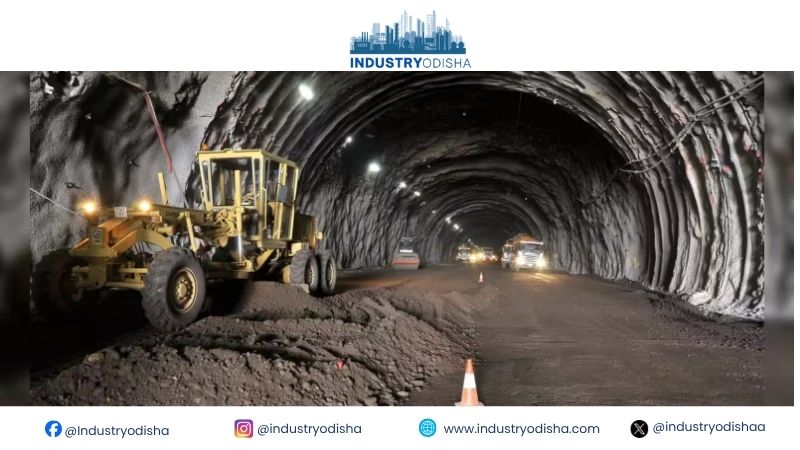
Industry Odisha Bureau, Oct 24: India is expanding domestic manufacturing of tunnel boring machines, the railway minister says. The 125-km Rishikesh–Karnaprayag rail line shows why such equipment matters in th Himalayas.
India is expanding domestic manufacturing of tunnel boring machines (TBMs), the government says. The push comes as construction advances on the Rishikesh–Karnaprayag rail line in Uttarakhand. Around 83% of the 125-km route runs underground. That makes tunnelling the project’s central engineering task.
TBMs are large machines that cut through rock and soil. They also support the surrounding ground as the tunnel is dug. Their design matters greatly in complex or unstable terrain.
Railway Minister Ashwini Vaishnaw said India once imported all its tunnel boring machines. He said 8-metre-diameter machines are now made entirely within the country. Production of 15-metre-diameter TBMs has also begun, according to the minister. He pointed to a TBM plant in Tamil Nadu. Machines wider than 16 metres will follow soon, he added. Vaishnaw described the effort as spanning design, manufacturing and maintenance.
Details of component sourcing and production volumes were not disclosed. It is also unclear how many domestic machines work on the Himalayan route.
The timing matters. China has imposed fresh restrictions on TBM exports, The Economic Times reported. India had earlier relied on imported machines for major tunnelling work. Domestic supply could reduce exposure to such external disruptions. It may also ease access to spare parts and servicing.
The Rishikesh–Karnaprayag line stretches 125 km through Uttarakhand’s hills. It will have 12 stations, 16 main tunnels and 19 bridges. Vaishnaw has described the line as a lifeline for the state’s future.
Building through the Himalayas poses distinct geological risks. These are young fold mountains, still geologically active and often fractured. In parts of this terrain, soft ground squeezes inward after excavation. Engineers call this “squeezing ground”. It can deform tunnel walls and trap boring equipment.
Vaishnaw said engineers modified the TBMs used on the project. The cutter head, which grinds the rock face, was adjusted. The shield, a steel casing protecting the machine and crew, was also changed. A new drive system delivers extra torque and thrust. Torque is rotational force, while thrust pushes the machine forward. Together, they help the machine keep moving through deforming ground.
Once complete, the line should improve rail links across Uttarakhand. It will ease travel to Karnaprayag and Rudraprayag. Pilgrims could reach Kedarnath and Badrinath more easily through onward road journeys. Better access may also support tourism and local commerce. Karnaprayag lies about 123 km from the India–China border, Vaishnaw said. That gives the project strategic value for transport in the region.
Wider TBMs could serve other underground projects too. Metro railways, highway tunnels and hydropower schemes rely on similar equipment. Larger diameters allow bigger tunnels, such as those for twin tracks or roads. Domestic capability could therefore support India’s growing pipeline of underground infrastructure.
Its real test lies in sustained output and performance in difficult ground. Turning ministerial plans into steady production will decide its long-term impact.
