



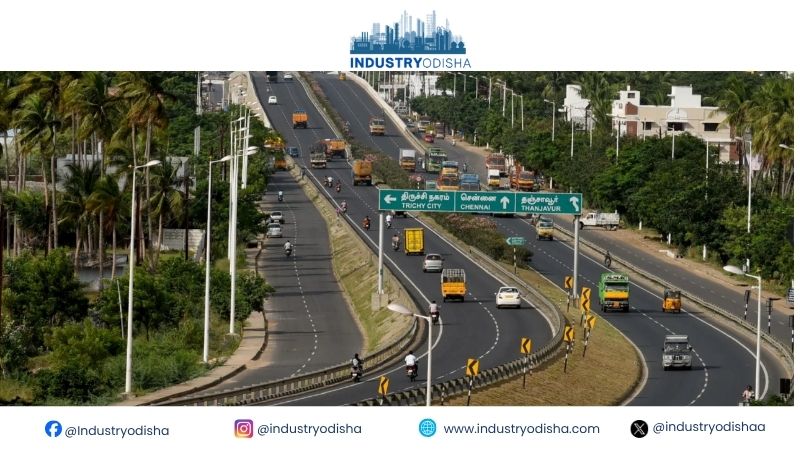
Industry Odisha Bureau, Oct 21: India plans ring roads and bypasses with strict access control to curb urban congestion. Motorists would pay by distance, but experts say planning matters more.
India plans to build ring roads and bypasses that stay fast as cities grow. The Ministry of Road Transport and Highways (MoRTH) has finalised a revised urban decongestion policy.
National highway projects meant to curb urban congestion must now be fully access-controlled. Access control means vehicles enter and exit only at designated points. Such corridors need at least four lanes and closed tolling. The aim is to sustain intended speeds of 100–120 kmph. They should also separate long-distance passenger and freight traffic from local movement.
Earlier ring road and bypass plans lacked such access rules. Shops, homes and businesses soon sprang up along them, a pattern called ribbon development. Frequent crossings then slowed traffic, eroding the value of public investment.
Under closed tolling, motorists pay for distance travelled, not a flat entry fee. Low-traffic city exits may be exempted, a person aware of the plans said. There, tolling infrastructure may not justify its cost. Such exemptions aim to ease the burden on local commuters.
Mint reported in June that a ₹2 trillion programme was planned. It envisages a 10,000-km network around 400–500 cities and towns. Cities with 500,000 or more people come first, followed by those with 100,000 or more. Smaller northeastern and hilly towns may be considered case by case.
A MoRTH study of 83 cities with over 500,000 people underlines the urgency. In 80, highway speeds fell over 10% through urban stretches. Bypasses or ring roads are already addressing this in 32 cities. Interventions must still be planned for the other 48.
Major interchanges will be at least 5 km apart. They will connect national and state highways, major district roads and planned city arterials. Slip roads will serve other public roads. City-side service roads will carry local traffic off the main carriageway.
Corridors must align with city master plans spanning up to 50 years. States must notify a 15-metre prohibited development zone on either side. They should also consider regulated zones up to 2 km on either side.
States would contribute through land acquisition cost-sharing or land pooling. Reimbursing state GST and mineral royalties are other options. So is value capture, which recovers part of rising land values nearby.
PwC India’s Devayan Dey sees congestion as often more an urban planning problem. He urged city-specific planning before major investments. Deloitte India’s Anurag Gupta said access control could preserve a bypass’s purpose. But it needs sound interchanges, service roads and strict development curbs, he added.
Sanjay Kumar Sinha of Chaitanya Projects Consultancy flagged risks. Poor access points, weak link roads or steep tolls could push commuters back into towns.
Roads alone will not curb urban congestion. Success will hinge on planning, land-use discipline and fair access for commuters.
