



Industry Odisha Bureau, Oct 16: India says the pact’s first phase is finalised and now in legal drafting. New Delhi wants an export edge before operationalising it. Sitharaman also urged the IMF and World Bank to respond faster.
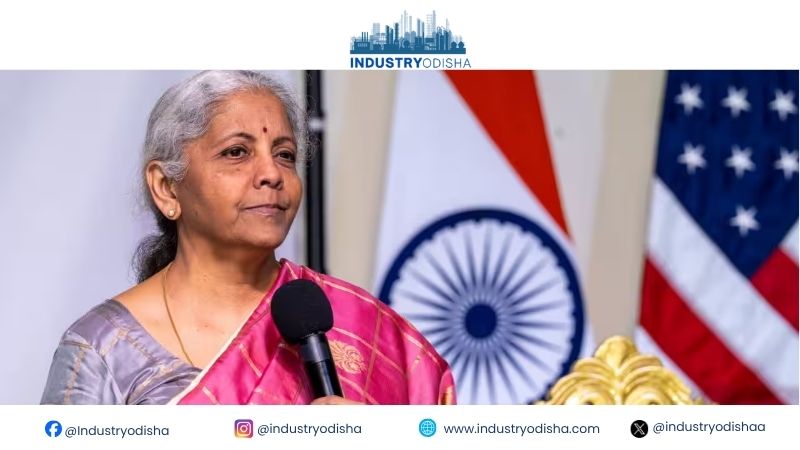
Finance minister Nirmala Sitharaman wants the India-US trade deal sealed without delay. She said on Friday that early closure would benefit bilateral and global trade.
Sitharaman was speaking with foreign policy expert Michael Kugelman at the Atlantic Council. The conversation took place in Bangkok, alongside the World Bank and IMF annual meetings.
Commerce minister Piyush Goyal said on Thursday the first phase is finalised. It is now being legally drafted. He said it would be operationalised only once India gains an export edge over rivals.
US ambassador Sergio Gor said on Thursday talks were moving at an “incredible pace”. He added that the “big items are done”. Still, signing and implementation remain separate steps, and no timeline has been announced.
In February, the two countries agreed a framework for the proposed deal. It cut the punitive US tariff on most Indian goods to 18%. That levy had been set at 50% in August 2025.
The US remains India’s largest goods export destination. Shipments there rose 11% year-on-year to $50.8 billion in the first half of FY27. A full deal could lock in that access and aid planning.
Meanwhile, a new US law allows tariffs of up to 100% on Russian oil buyers. It empowers President Donald Trump to levy such duties. The measure has added to India’s discomfort. New Delhi has vowed to protect energy security for its 1.4 billion people.
India, she noted, has been the fastest-growing major economy since 2021-22. GDP expanded 7.8% in the June quarter, beating expectations. This month, the World Bank and IMF lifted their FY27 forecasts to 7.1% and 7%. The upgrades ranged from 50 to 60 basis points.
She credited public capital expenditure for much of this resilience. Infrastructure spending, she argued, delivers a bigger multiplier than direct cash handouts. The Centre stepped up capex after 2020 to revive the pandemic-hit economy. It sustained that push to offset subdued private investment.
FY27 capex is budgeted at ₹12.22 trillion, up from ₹3.36 trillion in FY20. Including capital grants to states, effective capex is budgeted above ₹17 trillion. That is roughly 32% of the total budget.
Private investment is now reviving. Gross fixed capital formation grew 11% in the June quarter, a three-year high. Still, public spending stays vital as the West Asia war stokes uncertainty. Sitharaman said the government cannot splurge, while backing inclusion, skilling and the vulnerable.
On reforms, she urged the World Bank and IMF to be more “nimble-footed”. As Bretton Woods institutions, she said, they must meet 21st-century expectations. Middle-income nations can suddenly slide into severe balance-of-payments trouble. She said aid cannot arrive years after desperate requests. Such problems, she added, are now being corrected.
Sri Lanka, Argentina, Egypt, Ghana and Zambia have each faced external balance crises recently. She also flagged stablecoins, central bank-backed currencies and technology-driven cross-border payments as new challenges.
Her pitch thus spanned trade access, domestic investment and faster global crisis support. The legal text of the trade deal remains the immediate watchpoint.
