



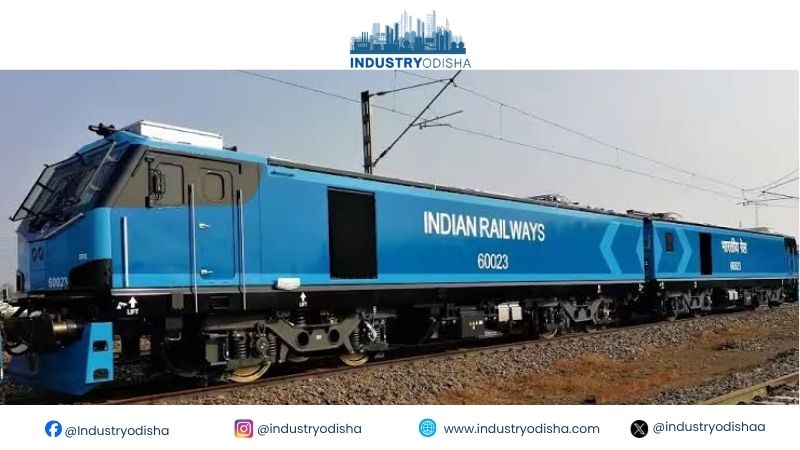
Industry Odisha Bureau, Sep 27: India’s first LNG-powered train was flagged off in Gujarat on Sunday. Railway diesel use is shrinking fast. Electrification is nearly complete. The open question is where alternative fuels now fit.*
Indian Railways has put a gas-powered train on its tracks. The timing looks unusual. Diesel use across the network is falling steeply. Electric traction now covers almost the entire system. Union Home Minister Amit Shah said 99.6% of the network is electrified.
So why introduce a new fuel now? The answer matters for Indian Railways’ wider energy transition.
A first run, not a fleet plan
Shah flagged off India’s first LNG-powered train on Sunday. The launch took place at Sabarmati Railway Station in Ahmedabad, Gujarat. The train runs on liquefied natural gas, or LNG. This is natural gas cooled into liquid form for storage. It remains a fossil fuel, offered here as an alternative to diesel.
An LNG-powered DEMU engine was displayed at the event. DEMU stands for diesel-electric multiple unit, a self-propelled passenger train. The launch also featured 1,200-horsepower twin-capacity engines. That figure describes power output, not fuel efficiency. Details released so far do not specify a route, fleet size or national rollout.
Wires are winning the network
Railway electrification in India has accelerated sharply. Shah said just 75 kilometres were electrified in 2010-11. In 2023-24, the railway electrified 7,188 kilometres in a single year. He said the remaining network would also be completed. He noted only Sweden has full electrification, on a far smaller network.
Electric trains draw power from overhead lines instead of burning fuel onboard. LNG trains, by contrast, carry their own fuel. The two technologies are distinct.
Diesel in retreat
The railway’s fuel mix is already shifting. Railway diesel consumption has fallen from 293 crore litres, Shah said. It stood at 108 crore litres in 2024-25. The government aims to bring diesel use to zero by 2030. Shah linked that goal to savings in foreign exchange. It remains an ambition, not an achieved result.
The launch details say nothing on LNG sourcing, costs or emissions.
Where does gas fit?
This is the central puzzle. A nearly electric network would seem to leave little room for new fuels. Yet large rail systems rarely switch technologies overnight. Different traction types often coexist during long transitions.
LNG trains run independently of overhead wires. That separates them clearly from electric locomotives. Shah called the launch an important step for environmental conservation. However, no emissions data was offered to support comparisons with diesel. LNG’s eventual scale on Indian Railways therefore remains unclear. A single first deployment does not settle that question.
The real test lies ahead
Separately, Shah inaugurated and laid foundation stones for several projects. Together they carry an investment of ₹1,472 crore. That sum covers multiple projects, not the LNG train alone.
The Gujarat launch shows LNG propulsion has entered Indian rail operations. It does not yet define LNG’s commercial role. That will depend on performance in regular service. It will also depend on how gas fits a network running largely on electricity.
For now, India’s first LNG-powered train is a test of fit, not fleet.
