



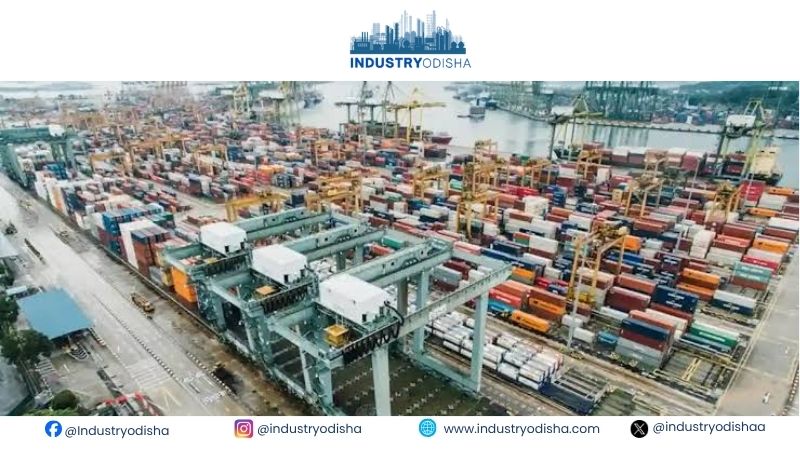
Industry Odisha Bureau, Sep 27: India has begun work on a port-based e-methanol facility at Kandla. The ₹2,300 crore project targets 150 tonnes a day. Its intended buyers are international ships on the Asia-Europe route.*
India is placing green-fuel production right beside its shipping lanes. The government has laid the foundation stone for a port-based e-methanol facility at Kandla. The plant sits within the Deendayal Port Authority in Gandhidham, Gujarat.
It will cost ₹2,300 crore and produce up to 150 tonnes daily. DPA is developing it jointly with Namrup-based Assam Petro-Chemicals Ltd.
The model is what makes the project notable. Here, fuel production and maritime demand share one location.
Two stages, two deadlines
The facility will be built in scalable modules. Phase I adds 50 tonnes a day for ₹1,200 crore. It is targeted for completion by January 2027.
Phase II adds another 100 tonnes daily for ₹1,100 crore. Its target date is March 2027. Both figures are planned capacities, not current production.
DPA and APCL share capital contributions in a 76:24 ratio. DPA’s share includes ₹567.32 crore of equity and 75 acres of land. It will also supply desalinated water and renewable energy, including green hydrogen.
Ships as the target market
The plant is aimed at international shipping rather than domestic buyers alone. Its intended customers are vessels on the Asia-Europe trade corridor. The official statement calls this one of the world’s busiest trade routes.
Producing fuel at a port could shorten the path to those vessels. Production, storage and supply could sit within one maritime hub.
The statement names no confirmed buyers or supply agreements. For now, international demand remains an intended market, not a secured one.
A cost claim to test
The official statement makes an ambitious cost claim. It says Kandla could produce green methanol at $750 a tonne. It compares this with a global rate of $1,300 a tonne.
Both figures come from the government statement. They have not been independently verified. If achieved, lower costs could strengthen the plant’s appeal to shipowners.
How the fuel is made
E-methanol is distinct from ethanol and from conventional methanol. The Kandla plant will use renewable power, water and biogenic CO₂. Green hydrogen forms part of the renewable-energy inputs DPA will provide.
An ecosystem around the port
The statement says the project could create over 3,500 direct and indirect jobs. It expects activity in transportation, storage, supply and related ancillary industries. These are official projections, not confirmed outcomes.
Union Shipping Minister Sarbananda Sonowal framed the project within India’s maritime ambitions. He said India would help power global ships with green energy.
The larger maritime bet
Kandla offers an early test of a new model for Indian ports. Can port-based production build an efficient fuel supply chain? Will international shipping supply enough demand? And can costs match the official promise?
The answers will emerge only once the modules start running.
