



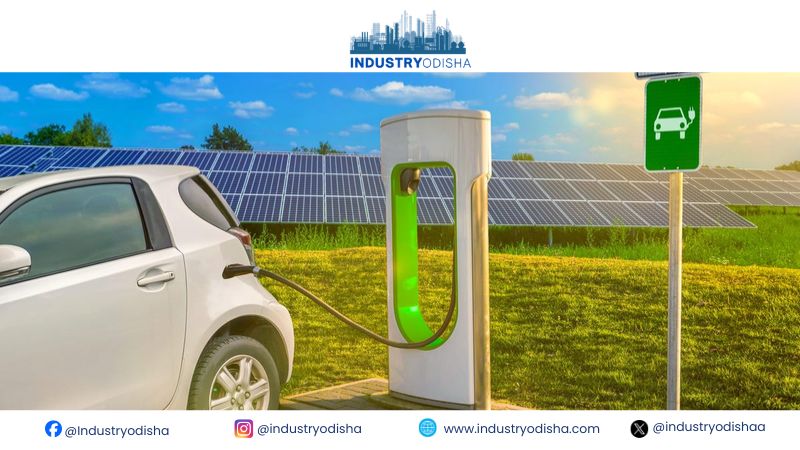
Industry Odisha Bureau, Aug 25: State-run banks and financial institutions have proposed changes to India’s priority sector lending framework that would create specific financing categories for electric vehicles, charging infrastructure and climate-transition projects, potentially expanding institutional credit to sectors central to the country’s energy transition.
The proposals, discussed at a two-day public sector bank confluence in New Delhi and reviewed by Mint, would introduce lending limits of up to ₹2 lakh for electric two-wheelers and ₹20 lakh for electric four-wheelers purchased for personal use. They also propose limits of ₹25 crore for charging and battery-swapping infrastructure and ₹50 crore for commercial electric-vehicle fleet operators, according to two government officials and documents reviewed by the publication.
Current Priority Sector Framework
Under the Reserve Bank of India’s priority sector lending framework, domestic scheduled commercial banks are required to direct 40% of adjusted net bank credit (ANBC) or credit equivalent of off-balance-sheet exposures (CEOBE) whichever is higher towards identified sectors. Within this requirement, banks must allocate 18% towards agriculture, 7.5% to micro enterprises and 12% to advances to weaker sections.
Currently, electric vehicles do not have a separate category under this framework. Retail EV purchases can qualify for priority sector treatment only when the borrower is an eligible micro, small and medium enterprise. Charging and battery-swapping infrastructure has no specific priority sector provision.
Expanding EV Credit Access
The proposed changes would create a dedicated lending regime for electric mobility by establishing distinct categories and loan ceilings for different vehicle segments and infrastructure. The ₹2 lakh limit for two-wheelers and ₹20 lakh for four-wheelers would target retail buyers, while the infrastructure limits would address financing gaps for entities developing charging networks and battery-swapping facilities. The ₹50 crore ceiling for commercial fleet operators would support businesses transitioning heavy-use vehicles to electric powertrains.
These proposals assume particular significance as India’s EV market expands amid persistent financing constraints. The country has more than 2.8 million registered electric two-wheelers, around 800,000 electric three-wheelers and nearly 200,000 electric passenger vehicles, according to Vahan-based data. In the fiscal year ending March 2026, retail sales reached 14,01,818 electric two-wheelers, 8,30,819 electric three-wheelers and 1,99,923 electric passenger vehicles, according to the Federation of Automobile Dealers Associations.
Financing as a Critical Bottleneck
Nearly 80% of vehicle purchases are financed rather than purchased outright, yet access to retail credit remains a persistent constraint for EV adoption, particularly for two- and three-wheelers where financing costs and loan availability have often lagged internal-combustion-engine vehicles. Only about 20% of vehicles are purchased outright, according to Amit Bhatt, managing director for India at the International Council on Clean Transportation.
Welcoming the proposal to bring EVs under the priority sector framework, Bhatt said extending benefits to charging and battery-swapping infrastructure is equally important. “Vehicle-side electrification alone will not scale without viable financing pathways for infrastructure providers,” he said.
Climate and Transition Lending
The banks have also proposed establishing a 2% climate and transition sub-target within the existing 40% priority sector requirement. This designation would not increase the overall requirement but instead carve out a specific allocation for climate-related projects. Eligibility could be determined using the Ministry of Finance’s climate finance taxonomy and the RBI’s interim list.
Renewable Energy Financing
The proposals also seek technology-differentiated lending limits for renewable energy projects. The existing ₹35 crore limit for solar photovoltaic projects would be retained, while limits for wind and small hydro projects would increase to ₹75 crore each. An overall ceiling of ₹100 crore per borrower from the banking system has been proposed.
The differential approach reflects varying capital requirements across technologies. The ₹35 crore limit can support approximately 8–10 megawatts of solar capacity but materially less wind and small-hydro capacity, according to the proposal. A uniform lending cap therefore provides relatively greater financing headroom to lower-cost technologies on a per-megawatt basis, while accommodating the different economics of higher-cost renewable technologies.
Energy Transition Timeline
These renewable-energy proposals come as India pursues acceleration of its clean-energy transition toward a stated target of 500 gigawatts of non-fossil-fuel-based electricity generation capacity by 2030. As of 31 July 2026, India had 291.73 gigawatts of installed renewable-energy capacity, according to Ministry of New and Renewable Energy data.
Banking Sector Positioned for Expansion
The proposals emerge at a time when state-owned banks are in a stronger financial position to expand lending. The 12 state-owned banks recorded aggregate business of ₹283.3 trillion as of 31 March 2026, representing year-on-year growth of 12.8%, according to Ministry of Finance data. Deposits grew 10.6% to ₹156.3 trillion, while advances increased 15.7% to ₹127 trillion.
Asset quality has also improved. The gross non-performing asset ratio fell to 1.93%, while the net NPA ratio declined to 0.39%. The banks recorded aggregate operating profit of ₹3.21 trillion, with net profit rising 11.1% year-on-year to ₹1.98 trillion the fourth consecutive year of profitability for public sector banks.
Pending Approval
The proposals have not yet been accepted by the government or incorporated into the priority sector lending framework. Queries emailed to the Ministry of New and Renewable Energy, the RBI and the Ministry of Finance remain unanswered. If approved, they would provide banks with a more clearly defined lending regime for electric mobility and energy-transition financing while maintaining the overall 40% priority sector requirement unchanged.
According to Tirath Khaira, director at Smarten Power Systems, the proposals are timely. “A more responsive financing environment can give businesses greater confidence to invest, scale and plan for the long term,” Khaira said, adding that the value of the reforms would lie in making capital more accessible, supporting innovation and capacity creation, and enabling wider participation across the energy ecosystem.
