



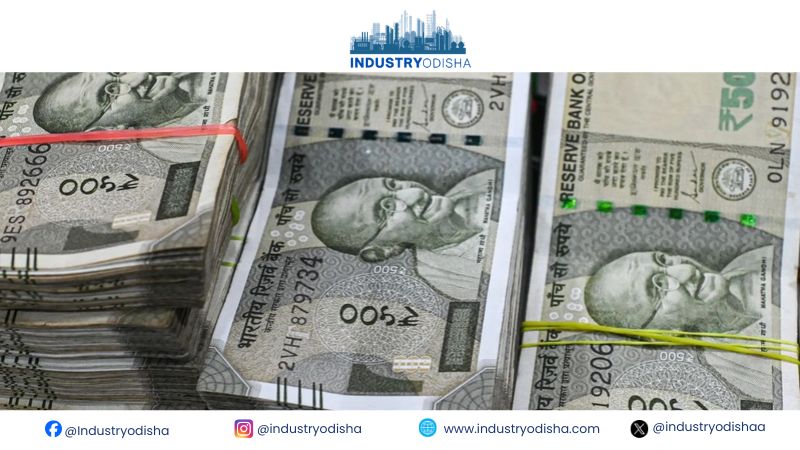
Industry Odisha Bureau, Aug 9: The Indian rupee’s near-flat close against dollar on Friday belied deeper market pressures stemming from geopolitical tensions and crude-oil volatility. Despite settling just 2 paise stronger at 95.20 per dollar, the rupee faced persistent headwinds from global risk aversion. Another reason being the uncertain negotiations between Iran and Oman over shipping routes through the Strait of Hormuz.
The dollar remained in demand as a safe-haven currency, while the rupee’s apparent stability masked underlying vulnerability to oil-price movements and shifts in international capital flows. Traders calibrated expectations for the rupee’s near-term path against this backdrop of geopolitical risk and energy-market uncertainty. On these lines, the dollar-rupee pair expected to remain volatile.
The Indian rupee’s intraday trading pattern opened at 95.27 and moved through a narrow 95.19–95.28 band before settling at 95.20 reflected competing forces. Foreign portfolio investors accelerated equity exits, selling shares worth ₹17.86 crore on a net basis on Thursday. Domestic equities retreated sharply: the Sensex shed 455.59 points to close at 78,499.17, while the Nifty fell 65.35 points to 24,570.65. These capital outflows increased dollar demand, offsetting gains the rupee might have captured from marginally softer global commodity prices.
Overnight crude movements amplified market nervousness. Brent crude traded at $82.30 per barrel, down 0.23%, but the commodity’s directional pressure came less from price levels than from uncertainty around Middle Eastern supply. Disruptions affecting the Strait of Hormuz would dramatically reshape India’s import bill and external-sector dynamics. The Hormuz Strait is responsible for roughly one-third of global seaborne traded oil passes. For a major crude importer confronting trade-deficit pressures, such geopolitical scenarios carry outsized significance.
The Dollar Index, gauging the greenback’s strength across major currencies, stood at 99.90, down marginally 0.025%. Yet this modest softening masks the dollar’s structural safe-haven appeal when emerging-market risk sentiment deteriorates.
Looking ahead, traders signaled particular focus on U.S. non-farm employment data, expected to influence dollar positioning. The rupee’s trajectory will likely depend on how global oil and geopolitical developments unfold. In the coming sessions, the USD-INR pair anticipated to trade between 95 and 95.60.
