

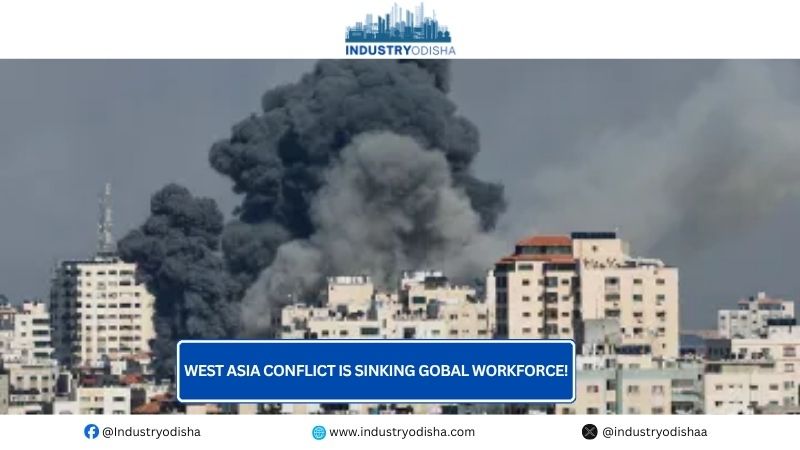
Industry Odisha Bureau, May 19: The West Asia geopolitical shock as well as the soaring input costs has not only come as a bolt from the blue for the Indian industries, but has also taken a toll on the human resources employed there along with the manufacturers feeling the pricks and pangs of margin erosion triggered by soaring input costs.
As per the analysts, instances galore across the country, while the gradually worsening scenario is apprehended to turn for the worst the more the geopolitical deadlock persists or escalates.
A case in point is the disrupted supply of polyester filament yarn (PFY). It is a raw material derived from crude oil. If a firm dealing in human wears made of PFY and imports it from China, the Hormuz hurdle is reportedly standing in the way since China reportedly imports over 50% of its crude oil needs through the globally critical chokepoint called Strait of Hormuz that Iran has already blocked and the woe has further been aggravated by the naval blockade imposed by the USA to teach it bête noire Iran a lesson.
If at all China affords to export the PFY raw material to this Indian firm out of its buffer stock, that is reportedly been done at a much higher cost resulting in catapulted input costs including dyes, chemicals and packaging materials apart from the PFY.
Following the reportedly shortage of LPG (cooking gas cylinder) supply along with its price hikes, majority of the migrant workers staying either in the industrial hostels or rented houses in the respective urban pockets have reportedly been back home in their repective native places.
Since the West Asia conflict broke out in the wee hours of February 28 this year and got escalated, worried workforce, who had earlier deserted their repective villages in quest of eking out a living in the urban rush, reportedly opted for going back home on furlough in the second week of March on account of celebrating Holi (festival of colours), but could not muster courage to dare the trials and tribulations thrust by the geopolitical shock and its repercussions.
Hence, analysts have found out from their ground reality surveys that the Indian firm manufacturing human wears is ironically smitten by shortage of human resources (labourers/workforce) along with the pecuniary pains being reportedly caused by higher input and transportation costs vis-a-vis a weaker rupee at present (Indian currency) in the international market.
Another case in point is “world’s second large Indian ceramic manufacturing cluster” claimed to be “accounting for 70% of India’s production and 90% of its exports” that reportedly “got shut down for 45 days owing to shortage of natural gas that entirely get imported from the West Asia region.”
While the aforesaid ceramic cluster reportedly “lost Rs 10,000 crore in revenue, the loss incurred by the cluster’s 700 units is estimated at Rs 1,500 crore.”
Even though the ceramic cluster reportedly got its required natural gas supply restored on May 1 and resumed production, the capacity utilization is reportedly below, while the colossal challenge now is reportedly the same higher input costs and shortage of workforce.
There are scores of such instances and their citings and elaborations would be very exhaustive to carry here, while needless to mention the woes being experienced by the Indian aviation sector due to the hike in the aviation turbine fuel (ATF) costs resulting in dearer airfares and passengers shying away to afford.
The startling revelation by the analysts and market experts hints at “the monster of margin erosion higher than the revenue destruction.”
According to an analysis reportedly conducted by the CRISIL Intelligence (formerly known as Market Intelligence & Analytics) before the May 15 fuel price hike covering over 600 listed companies across 47 sectors, “the revenue growth in the first quarter of fiscal year (FY) 2026-27 estimated to be around 8% lower than the decadal average of about 9%.”
But, on the margin front, CRISIL Intelligence reportedly estimates “100 basis points (BPS) hit making margins the lowest in the last 12 quarters. It is grimmer for sectors dependent on crude oil and natural gas, and their margins are expected to decline by 300 BPS.”
Read More: Prolonged West Asia Conflict Making India’s Credit Recovery Momentum Lose Steam: Reports