



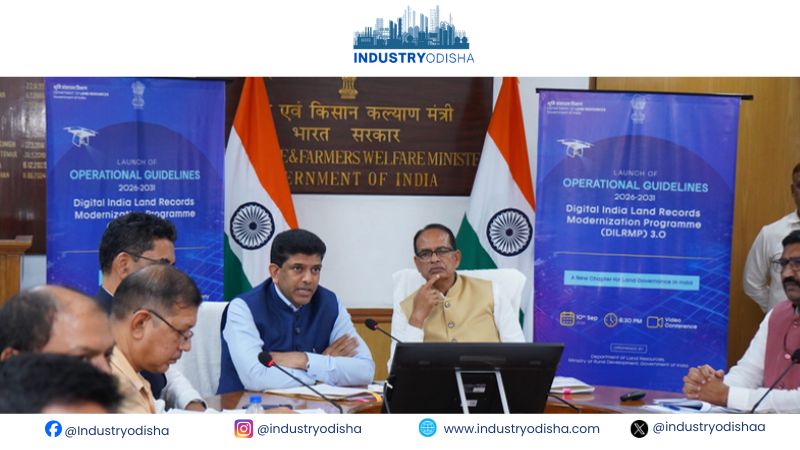
Industry Odisha Bureau, Sep 10: With the objective of making the country’s land administration system more modern, transparent, efficient and citizen-centric, the Digital India Land Records Modernization Programme (DILRMP) 3.0 will be implemented across the country. While DILRMP 2.0 laid a strong foundation for the digitization of Records of Rights (RoR), cadastral maps and registration systems, DILRMP 3.0 will integrate these systems into a reliable, interoperable and GIS-enabled Land Stack.
The programme will be implemented from April 1, 2026 to March 31, 2031, with a total financial outlay of ₹565.50 crore.
Union Minister, Rural Development, Shri Shivraj Singh Chouhan unveiled the operational guidelines of DILRMP 3.0. Ministers, Secretaries and senior officials from various States and Union Territories participated in the programme virtually. From Lok Seva Bhawan, Odisha’s Revenue & Disaster Management Minister Shri Suresh Pujari, along with senior officials of the Department, also participated virtually in the programme.
Under DILRMP 3.0, Land Stack will be developed as an integrated digital foundation for all land-related information, with cadastral parcels serving as the base spatial layer. Records of Rights (RoR), registration data, circle rates, land-related restrictions, land use, building plans and other relevant information will be integrated through interoperable APIs. ULPIN/Bhu-Aadhaar will serve as a common and unique parcel identification number for all land parcels.
The major objectives of DILRMP 3.0 include complete digitization, georeferencing and allocation of Bhu-Aadhaar (ULPIN) to all land parcels in rural, semi-urban and urban areas ; establishment of a spatially enabled and federated secure API architecture-based Land Stack ; digitization of all legacy land and registration records with easy search and access facilities; provision of authenticated and secure land services to citizens through secure identity verification and consent-based integration ; modernization and integration of the registration system for end-to-end digital property transactions ; strengthening and digitization of revenue court processes to reduce delays in mutation and land dispute resolution and enhance transparency; and creation of interoperable repositories and data-exchange mechanisms for seamless integration among various stakeholders involved in land administration.
On the occasion, Revenue Minister Shri Suresh Pujari said that the initiative under DILRMP 3.0 will be a significant milestone in transforming land administration into an integrated, digital, GIS-based and citizen-centric system. It will further strengthen transparency, security, convenience and faster delivery of land-related services to citizens.
Highlighting Odisha’s achievements under DILRMP , Minister Shri Pujari said that the State Government has already initiated several measures and is leveraging advanced technology to strengthen the State’s revenue administration. At present, Modern Record Rooms have been established in 311 out of the 317 Tahasils of the State.
High-tech survey is currently underway in Jharsuguda, Jagatsinghpur, Jajpur, Kendrapara, Kalahandi and Ganjam districts. So far, 1,99,86,487 Records of Rights (RoRs) in the State have been computerized. Similarly, cadastral maps or Bhu-Nakshas have been prepared for approximately 51,742 out of 51,802 villages in the State.Of the 321 Sub-Registrar Offices (SROs) in Odisha, 213 SROs have been computerized. The 108 new registration offices established in 2025 are also being equipped with modern technological infrastructure at the earliest.
Giving emphasis to capacity building and skill development of revenue field officials, a DILRMP Cell has also been established at the Revenue Officers’ Training Institute (ROTI), Gothapatna.
The Revenue & Disaster Management Department is continuously working with commitment towards making the revenue administration more transparent, efficient and people-centric through initiatives such as cashless and paperless registration systems, advanced monitoring technologies and other technology-driven reforms.
