



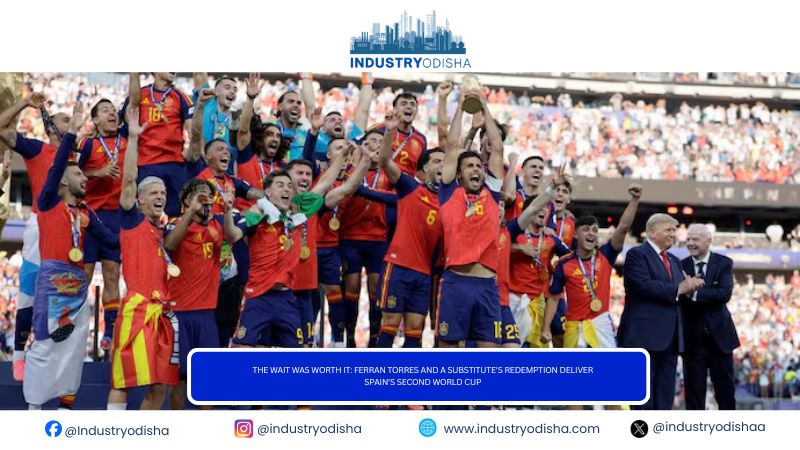
Industry Odisha Bureau, Jul 20: Emiliano Martínez had guessed right all night. Every cross, every half-chance, every scrappy delivery into his box, the Argentine goalkeeper had read and swallowed. Then, six minutes into the second period of extra time, he guessed wrong.
Pedro Porro’s cross was nothing special — the kind of hopeful, looping ball that had come and gone all evening without consequence. Nico Williams rose to meet it, more out of instinct than design, and could only glance a header back across the six-yard box. It should have been a formality for Martínez. Instead, he was already committed, already off his line, already beaten. Ferran Torres did not need to be asked twice. He arrived a half-step ahead of his marker and drove the ball high into the roof of the net.
It was the 106th minute. It was Spain’s only shot that mattered all tournament from a player who had missed his previous thirteen. And it was enough to end sixteen years of waiting and settle, at last, the most stubborn final in a generation.
A Final That Refused to Move
For long stretches of Sunday night at MetLife Stadium, it did not feel like a final being won so much as a final being endured. Luis de la Fuente’s Spain had the ball, as they always do — 68 percent of it by full time, by some counts closer to three-quarters in the second half — and they had the territory, and they had, by any reasonable measure, the better of the chances. What they did not have, for the longest time, was a way through.
Lionel Scaloni’s Argentina made a virtue of stubbornness. This was a team that had spent the tournament riding storms rather than avoiding them — ten of their nineteen goals in Group and knockout play had arrived after the 80th minute, evidence of a side built to absorb pressure and strike when opponents tired. But against Spain, that formula never had the chance to reveal itself in attack. Argentina did not manage a single shot on target in ninety minutes of regulation football. Not one. For a team that had reached the final playing some of the most opportunistic football of the tournament, it was a startling admission of how thoroughly they had been pinned back.
The sending-off of Enzo Fernández, dismissed for a second yellow card late in normal time, only tightened the vice. Argentina’s midfield, already stretched thin by the demands of containing Spain’s rotations, now had to do it a man short.
And yet none of it was enough. Spain probed and prodded and passed their way into good positions without ever quite finding the finish. When Nico Williams did poke a loose ball home early in extra time, the celebration lasted only as long as it took the referee to spot a foul by Mikel Merino in the buildup. The goal was chalked off, and the tension reset all over again.
The Ghost of 2010, and the Weight on De la Fuente
There is a version of this match that Spanish football has lived through before, and everyone inside MetLife Stadium knew it. In 2010, La Roja won the World Cup for the first time by the same allergic-to-goals scoreline — 1-0, in extra time, against a Netherlands side that fouled its way through the contest. Sixteen years on, De la Fuente’s team once again arrived at the final as reigning European champions, once again found themselves stuck at 0-0 deep into the match, and once again needed something scrappy and late to turn control into silverware.
That parallel matters beyond nostalgia. It speaks to a persistent tension in this Spanish side between aesthetic superiority and ruthless conversion — a team that dominates the how of a match far more comfortably than the when. De la Fuente’s decision to introduce Torres from the bench, along with the wider rotation of attacking options that had defined his squad management all tournament, was ultimately what broke the deadlock. It was not a masterstroke so much as an accumulation: Spain kept sending fresh legs and fresh ideas at a tiring Argentine backline until, eventually, one combination worked.
Only four World Cup finals have gone into extra time still scoreless — 1994, 2010, 2014, and now this one. Of those, only the 1994 meeting between Brazil and Italy required penalties to separate the sides. Spain’s ability to eventually manufacture something from very little, twice in three finals of this kind that they have contested, says as much about their patience and squad depth as it does about any single moment of quality.
Messi’s Long Goodbye
If there was a secondary story playing out on the pitch, it belonged to Lionel Messi, who has indicated this was likely his final World Cup match. For most of the night, he was curiously peripheral — crowded out by a Spanish midfield that had clearly been drilled to deny him space between the lines. It was only in the frantic, ten-man closing stages, with Argentina committing bodies forward in search of a way back into the match, that Messi began to look like himself again, drifting into pockets and demanding the ball. But the two half-chances Argentina scraped together in that final push never forced a save from Spain’s goalkeeper, and the story ended not with a Messi flourish but with Spanish players collapsing to the turf in relief near the corner flag.
It is a cruel footnote for a player who won it all four years ago in Qatar: a final World Cup appearance ending in a defeat built less on Argentina’s mistakes than on their simple inability to create anything at all.
A Defense Built for This Moment
Buried beneath the drama of the winning goal is a defensive achievement that will likely define how this Spain side is remembered. Across eight matches, they conceded precisely once — in the quarterfinal win over Belgium — the stingiest campaign by any champion in World Cup history. Combined with Sunday’s clean sheet, it capped an unbeaten run stretching to 38 matches: 29 wins and nine draws, a streak that surpasses even Italy’s 37-game run between 2018 and 2021, a mark it was Spain themselves who eventually ended.
That is the deeper explanation for why Argentina managed so little on the night. This was not one good defensive performance; it was the culmination of eighteen months of a team built, first and foremost, not to be beaten.
Two Crowns, One Nation
There is symbolism, too, in the timing. Spain’s women lifted the World Cup in 2023, and with Sunday’s result, the country becomes the only European nation to hold both the men’s and women’s titles simultaneously — a statement about the structural health of Spanish football at every level, from youth academies to senior tournament football, that a single scoreline cannot fully capture but nonetheless reflects.
For Argentina, the pain will linger longest around the specifics: a goalless ninety minutes, a red card that never should have needed to matter, and two moments — Williams’ disallowed goal and Torres’ converted one — separated by barely half an hour of extra time and an ocean of consequence.
For Spain, the wait is finally over. Sixteen years after Andrés Iniesta’s extra-time strike beat the Netherlands in Johannesburg, another substitute, in another final, in another country entirely, has written his name into the same short list of players who scored the goal that made Spain champions of the world.
