


The headline figures glitter—$11.5 billion, 53,500 jobs, India’s largest metallurgical investment. But in Rayagada and Sundargarh, where bulldozers haven’t arrived and no contracts have been signed, locals will spend the next eighteen months watching officials map out their land, negotiate their displacement, and decide what tomorrow looks like for communities built on mineral-rich earth.
This is the part of megaproject economics that rarely makes the press release: the grinding, unglamorous work before construction begins.
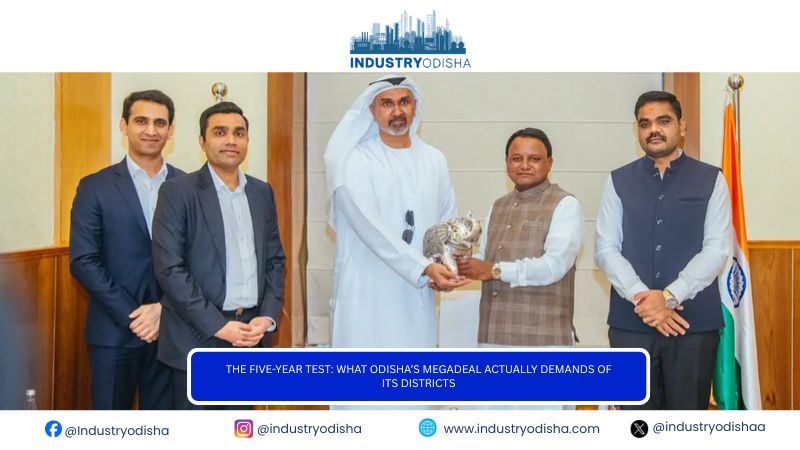
Adani Enterprises and Abu Dhabi’s International Resources Holding announced their 50-50 partnership last month to build an integrated aluminium corridor spanning the full value chain—from bauxite extraction through smelting to downstream manufacturing. The venture will anchor itself in the two districts that hold Odisha’s mineral wealth: the refinery in Rayagada, positioned near the ore deposits, and the smelter in Sundargarh. A 4,000-megawatt captive power station will feed the complex.
The state government has already cleared the path administratively. Chief Minister Mohan Charan Majhi has made it plain that land acquisition, environmental approvals, and statutory clearances—the machinery of industrial setup—will move without friction. It will take, according to Karan Adani, managing director of Adani Ports and Special Economic Zones, between twelve and eighteen months. Add the construction phase, another three and a half years, and the facility reaches full operation by 2030 or 2031.
That construction window promises 35,000 jobs. Another 18,500 will emerge once the smelters hum. But those numbers occupy the end of a chain that begins with land.
Water resources must be extended across districts. Power lines must run into rural areas. Logistics corridors need construction to move bauxite from mine to refinery and finished metal to market. The state has committed to orchestrating all of it. What remains unsaid—which villages will be affected, how many acres, what compensation will be offered—is likely to define the project’s actual reception far more than any investment figure.
Odisha has learned this lesson before, though perhaps not thoroughly enough.
The state’s industrial past is paved with ambitious announcements that collided with the complications of land acquisition and rehabilitation. Projects stalled. Communities protested. Delays stretched into years. The mineral-rich districts have seen this pattern repeat, and scepticism runs deep. Whether this venture becomes different—or whether it joins the catalogue of delayed greenfield projects—will reveal itself during that eighteen-month clearance window, not years from now.
The aluminium complex isn’t isolated policy. Chief Minister Majhi is weaving it into a broader industrial vision he calls “Samruddha Odisha 2036”—a deliberate repositioning of the state as it approaches its centennial. Rather than mining ore and exporting it as raw material, Odisha should refine and manufacture within its borders. The value stays. The jobs stay. Skilled work replaces extraction.
That philosophy now underpins a coordinated push beyond metals: a chemicals and petrochemicals cluster strategy, a green hydrogen workforce roadmap released this month, and an investor roadshow planned for Delhi in August focused on food processing. Each initiative gestures toward the same ambition—an Odisha that transforms resources, not merely extracts them.
The aluminium deal serves as template. If it works.
The next year matters disproportionately. How smoothly the state navigates land identification and acquisition, how quickly environmental clearances move through bureaucratic channels, and what terms the Odisha Mining Corporation sets for supplying raw material to the joint venture—these details will either enable or obstruct the project. They will determine not just speed but fairness, and fairness is what communities remember long after press releases fade.
The investment sum itself is beside the point now. The real story—whether this becomes a genuine employment and economic transformation for Rayagada and Sundargarh, or merely a figure cited in subsequent state reports—remains to be written. The next eighteen months will contain most of the plot.
