



Industry Odisha Bureau, Jul 25: The economics of spaceflight are undergoing a transformation as profound as any technological revolution of the past century. For decades, launching payloads to orbit was a fundamentally disposable enterprise rockets that cost hundreds of millions of dollars were treated as single-use vehicles, their sophisticated engineering discarded moments after completing their mission. This economic absurdity began to change with reusable boosters, but the vision of a fully reusable launch system capable of rapid turnaround and drastically reduced costs has remained the frontier of aerospace engineering.
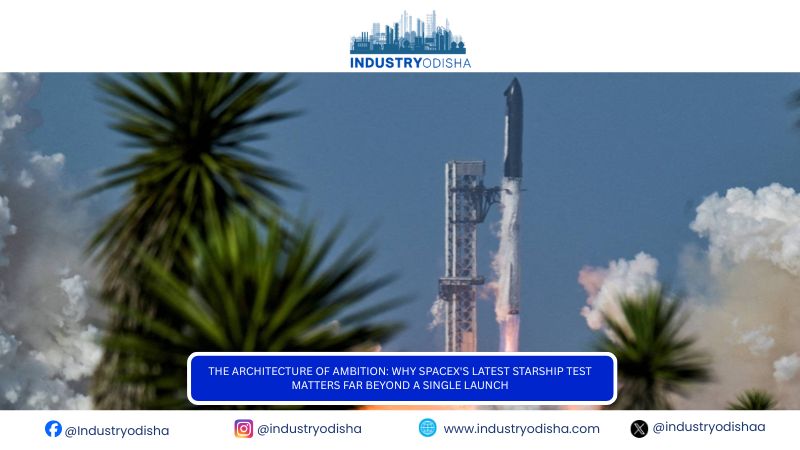
SpaceX’s latest Starship test flight, conducted from its southern Texas facility, represents far more than another iteration in a development program. It exemplifies a fundamentally different approach to space transportation one where repeated flights, continued refinement and systematic testing of new technologies form the pathway to operational capability. The 407-foot vehicle embodies ambitions ranging from lunar exploration to human Mars settlement, but its present significance lies in the methodical validation of systems that will define spaceflight economics for decades.
Why Failed Boosters Matter
The replacement of six engines on Starship’s first-stage booster following the previous week’s launch abort might appear merely as corrective maintenance. In reality, it reflects a deliberate strategy that distinguishes SpaceX’s development philosophy from traditional aerospace approaches.
Conventional rocket programs treat engine failures as anomalies requiring investigation, redesign and extensive ground testing before resumption of flight operations. SpaceX’s iterative approach embraces flight testing as the primary laboratory for systems validation. The engine problems encountered in May which prevented booster landing and the abort on July 16 were not viewed as program failures but as data sources informing engineering improvements.
The decision to replace multiple engines and immediately resume testing represents confidence that the root causes have been identified and corrected. More significantly, it reflects the economic reality that rapid iteration at scale produces better engineering outcomes than prolonged ground testing of incrementally improved designs. This philosophy has proven controversial among traditional aerospace engineers, yet it has demonstrably accelerated the timeline toward operational capabilities.
For this particular flight, neither the booster nor the Starship spacecraft was intended for recovery. The booster splashed into the Gulf of Mexico after stage separation, while the spacecraft targeted the Indian Ocean following approximately one hour of flight. This deliberate expenditure of hardware costing tens of millions of dollars serves a specific purpose: gathering data on atmospheric entry conditions, heat-shield performance and spacecraft behavior during return from orbital velocity. For a fully reusable vehicle, understanding and perfecting re-entry represents the critical remaining engineering frontier.
The Heat Shield Challenge
Starship’s development toward full reusability hinges on solving problems that have challenged aerospace engineers since the early space age: protecting vehicles and their contents during the extreme thermal environment of atmospheric re-entry. The engineering intensity required to achieve this cannot be overstated.
Six newly deployed Starlink satellites carried cameras specifically positioned to photograph Starship’s heat shield during re-entry, providing unprecedented real-time imagery of thermal protection performance. Complementing this visual data, the heat shield itself was instrumented with sensors measuring temperatures and stresses during launch and re-entry phases. Additionally, some thermal protection tiles were deliberately painted white to simulate missing tiles a deliberate damage scenario designed to evaluate how heat-shield systems degrade and whether failures in one section propagate to adjacent areas.
This experimental rigor extends to the philosophical foundations of spacecraft design. The intent to catch Starship itself using giant mechanical arms at the launch site replicating the already-demonstrated booster capture technique requires certainty about thermal protection integrity. Any doubt about heat-shield reliability would render catch operations hazardous.
SpaceX aims to achieve this level of confidence through accumulated flight data rather than purely theoretical analysis. Each mission provides information about real hardware performance in actual re-entry conditions, contributing to a gradually expanding understanding of thermal dynamics at extreme altitudes and velocities.
The Starlink Context
The deployment of latest-generation Starlink satellites during this mission serves purposes extending well beyond satellite constellation management. These newest spacecraft incorporate advanced features including improved solar array deployment, laser communication capabilities for inter-satellite links, and enhanced onboard computing systems. Their successful orbital insertion and initial systems checks validate manufacturing improvements and operational refinements across SpaceX’s rapidly expanding satellite network.
SpaceX currently operates more than 10,000 Starlink satellites, constituting the world’s largest satellite constellation. This massive infrastructure represents not merely a commercial communications network but also serves as a testing ground for new satellite technologies and operational procedures. Each Starship flight that deploys new-generation Starlinks simultaneously advances both the launch vehicle’s capability and the satellite constellation’s performance characteristics.
The laser communication tests attempted between newly deployed satellites and older Starlinks already in orbit provide crucial data about inter-satellite link reliability and performance. These links form the backbone of Starlink’s global coverage capabilities and represent a technically demanding achievement in their own right.
The Artemis Imperative
NASA’s close monitoring of this Starship flight reflects the spacecraft’s central role in the agency’s lunar exploration strategy. Starship is destined to serve as the lunar lander for Artemis III the mission where astronauts will return to the Moon for the first time in more than fifty years.
This mission-critical application creates urgency around Starship’s development timeline. NASA requires the spacecraft to complete testing and demonstrate reliable orbital capability before it can be qualified as a lunar lander. The thermal protection validation occurring during re-entry tests constitutes progress toward this qualification goal. Each successful mission provides engineering data and operational experience essential before human crews can depend on Starship’s reliability.
The lunar lander role represents a profound shift in NASA’s approach to human spaceflight. Rather than developing specialized vehicles optimized for specific missions, NASA is adopting SpaceX’s philosophy of using fully reusable systems adapted for multiple roles. Starship’s versatility capable of deploying satellites, landing on the Moon, and eventually transporting humans to Mars represents a different organizational approach to space transportation than traditional government spaceflight programs have embraced.
The Mars Question
Beyond its role in Artemis, Starship embodies Elon Musk’s explicit ambition to establish human settlement on Mars. This long-term goal shapes engineering decisions made during testing flights and vehicle development. Lessons learned from re-entry testing apply directly to Mars missions, where vehicles returning from the Red Planet must survive even more demanding thermal environments.
The iterative testing approach visible in Starship’s development reflects recognition that creating a spacecraft capable of reliably transporting humans to Mars and returning them safely represents the most ambitious engineering challenge of the century. Rapid iteration through flight testing, accumulated operational experience, and systematic performance validation form the most plausible pathway to this goal.
Remaining Challenges
Despite progress demonstrated through successive flights, substantial engineering work remains before Starship becomes fully operational. Engine reliability must improve to production standards; thermal protection systems must achieve consistent performance across numerous re-entry cycles; launch-site recovery operations must mature from demonstration to routine operation; regulatory approvals for human spaceflight remain incomplete.
These challenges are expected in developing a completely novel class of spacecraft. The path forward depends on continued flight testing, accumulated operational data, and systematic refinement of systems demonstrated to be technically feasible but operationally incomplete. Starship’s development trajectory suggests this path remains achievable within the timeline NASA requires for lunar missions.
