


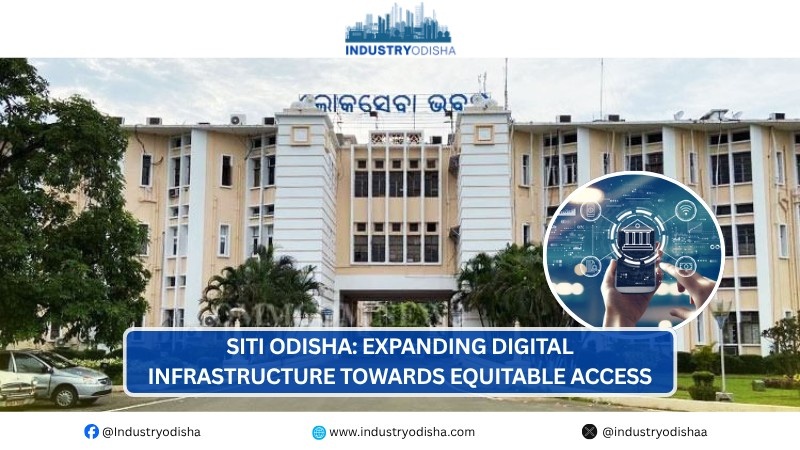
In alignment with Samrudha Odisha 2036 and Viksit Bharat 2047, government of Odisha recently announced the establishment of the State Institute for Transformative Initiatives (SITI), a think tank for policy research and strategic advisory body, with the chief minister as the head.
Modelled in line with Niti Ayog at the national level, SITI replaces the old State Planning Board, which was dissolved in 2024.
It will be headed by the Chief Minister as chairman, while a vice-chairman will be appointed to manage its day-to-day functioning. The institution will comprise four expert members, nine ex-officio members and two special invitees to provide domain-specific inputs and ensure effective policy implementation.
The think tank, which will work closely with various departments, experts and stakeholders to design and monitor development programmes aligned with the best global practices, is aimed at bringing greater agility and innovation into governance by replacing the earlier top-down planning approach with a collaborative and consultative model.
Why it is a significant move
Experts are of the opinion that the move marks more than an institutional reshuffle as it comes at a time when states are competing not with resources but with the quality of their ideas. It signals a shift in governance by focusing on an innovative, agile, evidence-based policy making, they add.
By emphasising on data driven policy making, the apex body can shift governance from intuition-driven decisions to evidence-based ones. As Odisha has struggled with gaps between policy intent and ground-level outcomes, the use of real-time data, impact assessments and feedback loops, can help the government design policies that work on the ground, reducing leakages and inefficiencies. If implemented effectively, SITI could ensure that public spending translates into measurable improvements in health, education and livelihoods.
Besides, while the planning commissions in the past focused on allocation and spending, SITI can bring in accountability by concentrating on result outcomes through better learning outcomes, improved health indicators and job creation.
Similarly, SITI can act as a central coordinating platform, ensuring that policies are aligned rather than fragmented. In other words, it can align policies across departments, guaranteeing coherence in execution.
Another key advantage is the institutionalisation of long-term thinking. It has been observed that political cycles often reward short-term decision making for political reasons, which often hinders the development, a long-term process. Creation of SITI is a step towards ensuring continuity in policy direction, irrespective of changes in leadership that could work in tandem with initiatives within broader frameworks such as ‘Samruddha Odisha 2036’ and ‘Viksit Bharat 2047’, which in turn could give impetus to large scale projects in infrastructure, industrial corridors or human capital investments.
Moreover, in an interconnected world where states are no longer insulated from global trends, be it technological disruption, supply chain shifts or climate risks, SITI can transform the state economically by providing an opportunity to deepen its engagement with global best practices by benchmarking Odisha against global standards, facilitate knowledge partnerships and adapt successful models to local contexts. This outward-looking approach could help the state leapfrog stages of development rather than follow a linear trajectory.
Most importantly, it can identify high-growth sectors, attract investments and design targeted interventions. Whether it is green energy, manufacturing, or digital economy, it can provide the intellectual backbone for Odisha’s next growth phase. SITI can analyse where the state holds a natural advantage: abundant mineral resources for advanced manufacturing, a long coastline for renewable energy and port-led development and a young workforce that can be trained for digital services. By combining data on global market trends with local capabilities, it can pinpoint sectors where Odisha can realistically become competitive rather than spread its efforts thinly.
Last but not the least, beyond designing policy, SITI can monitor execution, flag bottlenecks and push course correction.
