


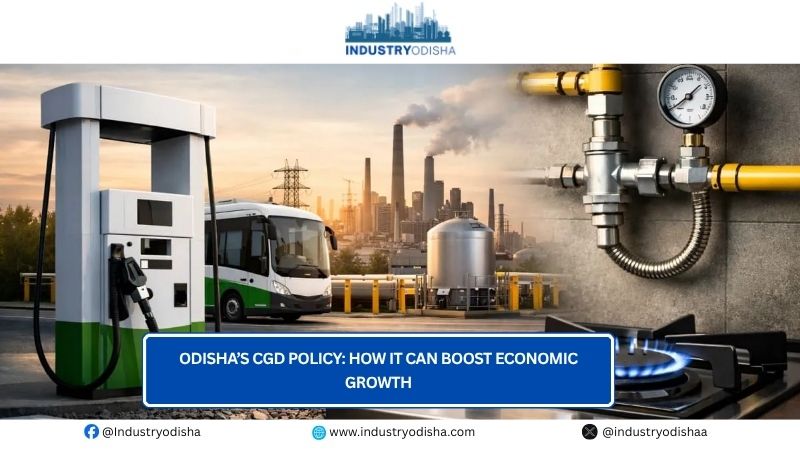
In a bid to expand city gas infrastructure across the state amid growing concerns over energy security and Prime Minister Narendra Modi’s call for energy conservation, Odisha government recently announced the Odisha City Gas Distribution (CGD) Policy to ensure faster and wider access to piped natural gas (PNG) for households and CNG for vehicles. The move is likely to pave way for piped natural gas (PNG) connections and compressed natural gas (CNG) stations in urban areas through a fast-track approval mechanism.
Under the CGD policy, 2026, the state has authorised five city gas distribution entities — GAIL (India) Limited, GAIL Gas Limited, Bharat Petroleum Corporation Limited, Adani Total Gas Limited and Megha Gas — to implement city gas distribution projects across urban centres in all 30 districts.
The policy aims to expand city gas infrastructure across all 30 districts, with targets of nearly 9 lakh PNG domestic connections and 271 CNG stations backed by investments of around ₹5,100 crore.
At a time when states are competing for investments in manufacturing and clean energy, Odisha’s push PNG and CNG infrastructure could fundamentally reshape the state’s economic landscape, feel analysts.
The significance
The advantages of the policy extend far beyond cleaner cooking fuel.
Industrial growth
As a mineral and manufacturing hub that houses major steel, aluminium and metal industries, Odisha has always been under pressure to reduce carbon emissions and adopt cleaner methods. The CGD policy will go a long way in providing industries with a cleaner, more efficient and cost-effective fuel alternative compared to coal or furnace oil by providing access to natural gas. This can significantly improve Odisha’s attractiveness for global investors seeking sustainable manufacturing destinations.
Generate employment opportunities
The policy can also become a catalyst for urban economic transformation. Expanding PNG pipelines and CNG stations across cities will require large-scale investments in infrastructure, engineering and logistics, which in turn can create new jobs for technicians, construction workers, engineers, transport operators and service providers. From pipeline installation to maintenance services, the CGD ecosystem can generate thousands of direct and indirect employment opportunities.
Improve urban living standards
Piped gas offers uninterrupted fuel supply, reduces dependence on LPG cylinders and improves convenience for households and commercial establishments. For restaurants, hotels and small businesses, PNG can reduce operational costs while ensuring a more reliable energy source.
Environment- friendly
Experts are of the view that wider adoption of CNG-based public transport and commercial vehicles can substantially reduce air pollution and improve public health outcomes, especially in the state’s growing urban centres such as Bhubaneswar, Cuttack and Rourkela which are witnessing increasing vehicular emissions and pollution pressures. Cleaner air will eventually translate into lower healthcare costs and better quality of life.
Energy security
As global fuel markets remain vulnerable to geopolitical disruptions and price volatility, diversifying the state’s energy mix through natural gas infrastructure reduces overdependence on conventional fuels will enhance long-term resilience.
Bridge the rural-urban economic divide
The promotion of compressed biogas (CBG) can create new opportunities for farmers and rural entrepreneurs. Agricultural residue, cattle waste and biomass can be converted into economic resources, generating additional income while supporting clean-energy goals. This creates a circular economy where waste itself becomes wealth.
Most importantly, the CGD policy aligns Odisha with the global transition towards cleaner and greener economies. As countries and corporations increasingly prioritise sustainability, states with modern energy infrastructure will hold a competitive advantage. Odisha can position itself not just as a mineral-rich state, but as a future-ready industrial economy powered by cleaner energy.
By linking clean energy with industrial expansion, urban development and job creation, the policy has the potential to redefine Odisha’s growth trajectory. If implemented with speed and efficiency, it can position the state as eastern India’s clean-energy and manufacturing hub, proving that future economic leadership will belong not merely to resource-rich states, but to reform-driven and infrastructure-ready ones.
