



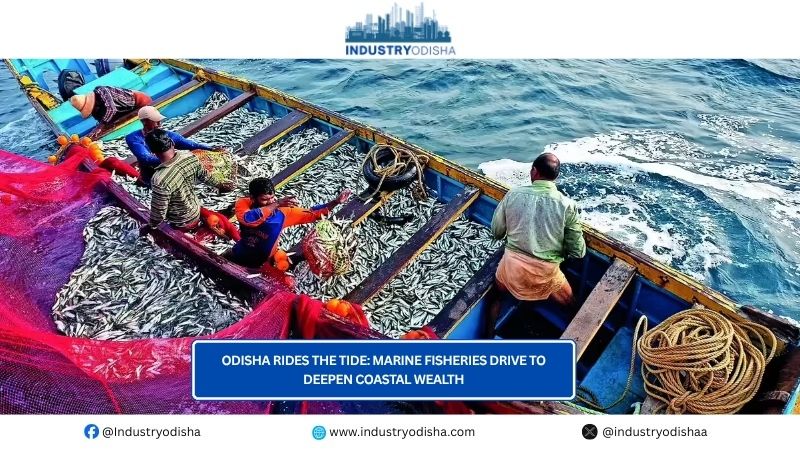
In a bid to regulate marine fishing, the state cabinet of Odisha, presided over by Chief Minister Mohan Charan Majhi, cleared a proposal to enact the Odisha Marine Fishing Regulation Bill, 2026.
Aimed at establishing a robust, modern and inclusive legal framework for the marine fisheries sector, the new legislation will repeal a 44-year-old law that regulates marine fishing activities in the state.
Odisha’s marine sector already holds considerable economic importance. According to the Odisha Economic Survey 2025-26, marine exports grew from ₹3,243 crore in 2019-20 to over ₹4,708 crore in 2024-25. Marine products now contribute nearly 5% of the state’s total merchandise exports. Yet this remains only a fraction of what the state can potentially achieve. The government’s ambitious target of ₹25,000 crore in seafood exports by 2036 underlines the scale of its aspirations.
With Blue Economy gaining momentum across the globe, a coastal state like Odisha, blessed with a 575-km shoreline and abundant marine wealth, can take advantage by tapping the full potential of its Blue Economy.
In this context, the newly approved Odisha Marine Fishing Regulation Bill, 2026, could become a game changer. The new Bill, which replaces the outdated Orissa Marine Fishing Regulation Act of 1982 — a law framed in an era when marine governance was limited to basic licensing and fishing restrictions, acknowledges the marine economy that has undergone sea changes.
With issues such as deep-sea fishing, export competitiveness, marine conservation, coastal security, vessel tracking and global seafood compliance demanding a modern framework, the Bill is fundamentally an economic reform aimed at strengthening Odisha’s marine market ecosystem—from fishermen and exporters to processing industries, logistics, cold chains and global seafood trade.
How will the new Bill boost the state’s marine wealth
The biggest economic promise of the Bill lies in its export ambition. Odisha already ranks fourth nationally in fish production, producing nearly 1.2 million tonnes annually. Per capita fish consumption in the state has reached 19.16 kg — almost double the national average. Yet much of Odisha’s marine economy still operates at a low-value level, dependent on shallow-water fishing and inadequate infrastructure. By promoting deep-sea fishing, the legislation can push Odisha into high-value marine harvesting. Tuna, squid, cuttlefish and deep-water shrimp command premium prices in international markets such as Japan, the European Union and the United States. The state’s Deep-Sea Fishing Mission plans to build 150 new deep-sea vessels and upgrade 500 mechanised boats over the next five years.
Mariculture — marine cage farming, seaweed cultivation and artificial reefs— is yet another benefit. Globally, seaweed, used in pharmaceuticals, cosmetics, food processing and biofuels, has become a multi-billion-dollar industry. Odisha’s long coastline and saline ecosystem offer ideal conditions for this sector. Instead of depending solely on fish catch, coastal communities can diversify income through marine farming.
Bill’s emphasis on technology is another opportunity for marine economy. Mandatory transponders, vessel tracking systems, biometric identification and VHF communication systems will improve not just security but also efficiency and international compliance. In global markets, particularly Europe and the US, traceability standards are becoming stricter. Buyers increasingly demand proof that seafood is legally sourced and sustainably harvested. Odisha’s new regulatory architecture can help exporters meet those benchmarks.
Employment generation is a bonus. Marine fisheries are labour-intensive and support lakhs of livelihoods directly and indirectly. From boat building and ice plants to seafood processing and transport, the ripple effects are enormous. Odisha has nearly 15 lakh fishermen dependent on the sector. Expansion of the marine economy can therefore create jobs at multiple levels, especially in coastal districts where employment opportunities are limited.
The Bill also strategically links fisheries with the larger ‘Blue Economy’ vision. Across the world, coastal economies are increasingly seen as engines of sustainable growth. Odisha’s efforts in marine biotechnology, seafood branding, shrimp exports and port-led development complement this larger ambition. The state is gradually building an ecosystem where fisheries, ports, exports, logistics and marine innovation reinforce one another.
If implemented with seriousness and speed, the Bill can do for Odisha’s marine economy what the IT revolution did for Bengaluru or what ports did for Gujarat — create jobs, exports, infrastructure and global market integration.
