

As the uncertainty in global energy markets loom large—from the Russia-Ukraine conflict to tensions in the Middle East and disruptions in key shipping routes, India’s proposed Strategic Petroleum Reserve at Chandikhol in Odisha assumes national importance.
The long-delayed crude oil reserve at Chandikhol in Jajpur district received a major boost, following the signing of strategic collaborative agreement between the Indian Strategic Petroleum Reserves Limited (ISPRL) and Abu Dhabi National Oil Company (ADNOC) during Prime Minister Narendra Modi’s recent visit to the UAE.
The state government has handed over land for what is set to become the country’s largest underground crude oil storage facility.
The Proposed Project
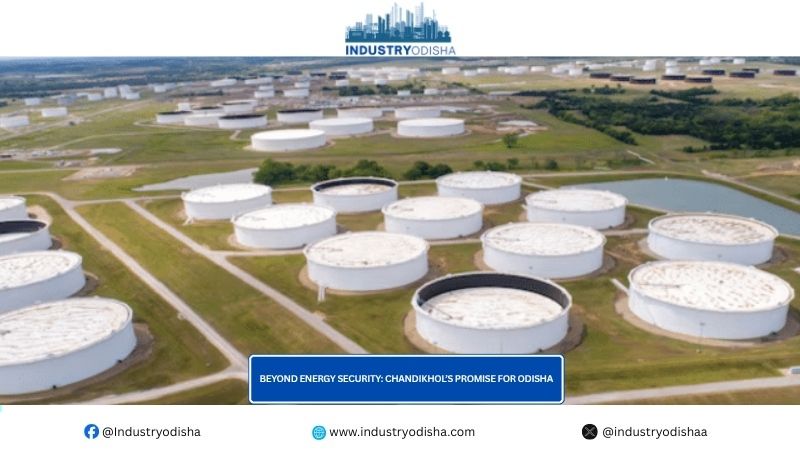
The Rs 8,743 crore underground oil storage facility in the state envisages potential ADNOC crude oil storage of up to 30 million barrels in India’s strategic petroleum reserves (SPR), including participation in facilities at Visakhapatnam and the proposed reserve complex at Chandikhol.
It aims to create a 4 million metric tonne (MMT) underground crude oil storage facility. Once completed, the facility will augment the country’s energy security buffer and strengthen the eastern coast’s role in the national petroleum logistics network.
Why It Assumes Significance
A shield against global oil shocks: Presently, India imports more than 80% of its crude oil requirements, making it highly vulnerable to disruptions caused by wars, geopolitical tensions, sanctions, or shipping bottlenecks. The Chandikhol reserve, which has the capacity of storing 4 million metric tonnes (MMT) of crude oil in underground rock caverns, can make a huge difference.
Combined with the planned expansion at Padur, India’s strategic reserves will increase significantly, adding around 11-12 days of emergency crude supply. This means the country can continue operating its refineries and economy even during major international crises.
Greater bargaining power in oil markets: Strategic reserves allow governments to buy crude when prices are low and release stocks during supply disruptions. India demonstrated this during the 2020 oil price crash, when filling existing reserves generated substantial savings. A larger reserve at Chandikhol will give India more flexibility to manage volatile oil prices.
Moving closer to global energy security standards: India currently has storage covering roughly 75 days of demand when strategic reserves, commercial inventories and oil in transit are combined. The country’s long-term objective is to reach 90 days of coverage, a benchmark followed by many advanced economies and linked to membership aspirations in the International Energy Agency. Chandikhol is a major step in that direction.
Strategic advantage on the east coast: Most of India’s existing strategic reserves are concentrated in southern India. A large reserve in Odisha will create geographic diversification, reduce vulnerability and provide quicker access to refineries serving eastern and northern India.
The proposed Strategic Petroleum Reserve (SPR) at Chandikhol is not merely a national energy security project; it has the potential to reshape Odisha’s economic landscape and strengthen its position in India’s industrial growth story.
The reserve will complement Odisha’s existing energy ecosystem centred around the 15-million-tonne-per-annum Paradip Refinery, one of India’s largest and most modern refineries. Together, these facilities will transform the Paradip-Chandikhol belt into one of the country’s most important energy corridors.
The economic benefits are significant. Large infrastructure projects of this scale generate thousands of direct and indirect employment opportunities during construction and operation. Beyond jobs, the project is expected to spur demand for local contractors, engineering services, logistics providers, transport operators, hospitality businesses and ancillary industries. The multiplier effect could extend across Jajpur, Cuttack, Jagatsinghpur and neighbouring districts.
Odisha’s strategic location on the east coast further enhances the project’s value. The state already handles substantial cargo through Paradip Port, one of India’s busiest major ports. The addition of a strategic oil reserve will strengthen port-linked industrialisation and encourage investments in petrochemicals, warehousing, storage terminals and energy-intensive manufacturing sectors.
The project also elevates Odisha’s national importance. Historically, India’s major energy infrastructure has been concentrated in western and southern states. By hosting the country’s largest strategic crude storage facility, Odisha will become a critical pillar of India’s energy security architecture. This increased strategic relevance can help attract future investments in refining, petrochemicals, green fuels and logistics.
