



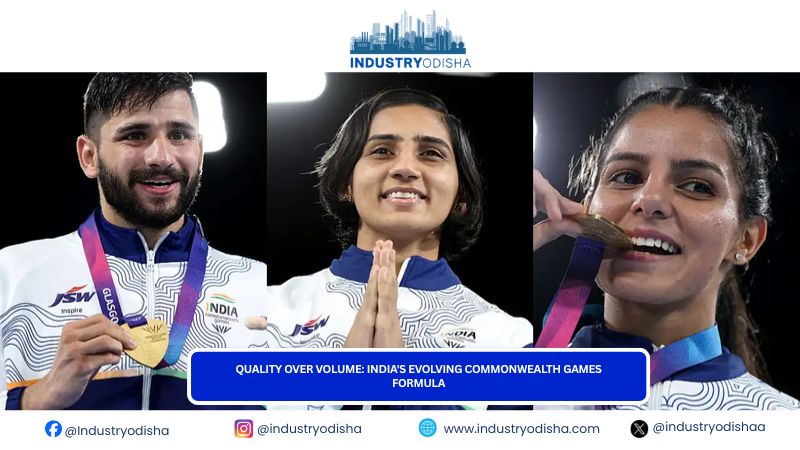
Industry Odisha Bureau, Aug 3: India’s medal tally at the 2026 Commonwealth Games 39 medals across five disciplines would have triggered concern a decade ago. The figure sits substantially below the 50-medal benchmark the country achieved consistently since 2002. Yet beneath this apparent plateau lies a more complex story about institutional maturation, elite athlete development, and the strategic reorientation of India’s high-performance sporting infrastructure.
The Glasgow Games, scaled down from its original Australian hosting plan due to financial pressures, forced a reckoning across all competing nations. With weightlifting, shooting, and other medal-accretive sports absent from the programme, India could not rely on traditional volume generators. What emerged instead was evidence of deepening competitive capacity across multiple, previously secondary disciplines.
The performance of India’s para-athletes crystallised this shift most sharply. A 28-member contingent returned with seven medals three gold, two silver, two bronze matching India’s cumulative para-sports medal count from all previous Commonwealth Games combined. Sharmila, Dilip Mahadu Gavit, and Soman Rana secured gold in para athletics events, signalling that adaptive sport infrastructure, once treated as peripheral within India’s elite development system, has gained institutional traction. This realignment reflects deliberate investment through programmes such as the Target Olympic Podium Scheme and sports science integration at national training centres.
Boxing’s breakthrough proved most dramatic. India claimed ten medals seven gold and three silver constituting the strongest boxing campaign in Commonwealth Games history across any nation. The women’s contingent led this surge, securing five gold medals, a performance that underscores the structural momentum building in female-athlete development pathways. Sachin Siwach and Ankush Panghal completed the men’s podium finishes, extending India’s growing reputation in combat sports coaching and talent identification.
Judo offered perhaps the most symbolic marker of institutional evolution. Harsh Singh and Asmita Dey became India’s first Commonwealth Games judo gold medallists, with Yamini Mourya and Unnati Sharma adding silver and bronze respectively. This breakthrough in a discipline where India had historically struggled reflects years of systematic investment in coaching expertise and international competition exposure cornerstones of the Khelo India initiative.
Athletics, constrained by the absence of medal-rich team events, still yielded ten medals, with Tejaswin Shankar becoming the first Indian decathlon medallist at a Commonwealth Games and Gulveer Singh claiming two podium finishes in distance events. Neeraj Chopra’s return to the podium after injury reinforced India’s depth in technical disciplines.
Weightlifting, though reduced on the programme, maintained its traditional excellence, with Mirabai Chanu securing her third consecutive Commonwealth Games gold a marker of sustained individual excellence within a disciplined, sports-science-supported training ecosystem.
The Glasgow campaign reveals an Indian sporting system calibrating toward quality benchmarks rather than medal aggregation. Building on this foundation, further gains may be achieved through expanded coaching networks, enhanced sports science integration, and continued international exposure for emerging athletes. The next phase of India’s Olympic preparation will likely depend less on programme availability and more on the institutional depth now taking root across boxing, para sports, athletics, and combat disciplines.
